

Geosynthetic Applications & Engineering Solutions
Modern civil and environmental projects rarely use a single geosynthetic product. A landfill liner system may require a geomembrane for containment, a nonwoven geotextile for protection, a geonet for drainage and a geosynthetic clay liner (GCL) as a secondary barrier. A road built over weak soil may combine woven geotextile and geogrid to provide separation, reinforcement and stabilization.
The right solution are according to the engineering function, not simply with choosing a product.
Planetliner supplies geosynthetic materials and integrated material solutions for civil engineering, environmental protection, transportation, mining, water containment, aquaculture and infrastructure projects.
Our geosynthetic products includes:
- Geomembrane:HDPE and LLDPE geomembranes; Smooth and textured geomembranes; Composite geomembranes
- Nonwoven geotextiles
- High-strength woven geotextiles
- Geogrids:PP Geogrid, PET geogrid
- Geosynthetic clay liners (GCL)
- Geonets and drainage geocomposites
- Geotubes
- 3D erosion-control geomats
All these materials can provide six basic engineering functions:
Barrier & Containment · Reinforcement & Stabilization · Separation · Filtration · Drainage · Erosion Control & Dewatering
The following guide helps engineers, contractors, project owners and distributors identify the appropriate geosynthetic solution according to the problem their project needs to solve.
Find a Geosynthetic Solution by Application
| Engineering Application | Typical Project Requirement | Recommended Geosynthetics |
|---|---|---|
| Sealing & Containment | Prevent liquid or contaminant migration | HDPE geomembrane, LLDPE geomembrane, textured geomembrane, GCL |
| Subgrade Stabilization | Improve weak road foundation | PP geogrid, woven geotextile, nonwoven geotextile |
| Soil & Embankment Reinforcement | Improve stability and distribute loads | PET geogrid, high-strength woven geotextile |
| Separation & Filtration | Prevent soil mixing while allowing water flow | Woven and nonwoven geotextile |
| Drainage Systems | Collect and transmit liquids or gases | Geonet, drainage geocomposite, nonwoven geotextile |
| Reinforced Slopes & Walls | Improve soil stability under tensile loading | PET geogrid, PP geogrid, high-strength woven geotextile |
| Dewatering | Separate water from sludge or sediment | Geotube, filtration geotextile |
| Surface Erosion Control | Reduce soil loss and support vegetation | 3D vegetation mat, geotextile, geogrid |
| Liner Protection | Protect geomembrane against puncture | Heavy-duty nonwoven geotextile |
| Composite Barrier Systems | Increase containment reliability | Geomembrane + GCL + geotextile + drainage geocomposite |
1. Sealing, Barrier & Containment Systems
Containment is one of the most important functions of geosynthetics material in environmental and hydraulic engineering.The objective is simple: control the migration of liquids, gases or contaminants between the engineered facility and the surrounding environment.
However, an effective containment system is not only a sheet of geomembrane.Depending on the project, a complete lining system may include:
Prepared subgrade → GCL → geomembrane → protection geotextile → drainage geocomposite → cover material
Where Are Containment Systems Used?
Typical industries and projects include:
- Municipal and industrial landfills
- Tailings storage facilities
- Heap leach pads
- Process water ponds
- Wastewater lagoons
- Reservoirs
- Irrigation ponds
- Aquaculture ponds
- Canals
- Secondary containment
- Biogas facilities
- Chemical containment areas
Recommended Products
HDPE Geomembrane
HDPE geomembrane is generally suggested where long-term containment, chemical resistance, UV resistance and dimensional stability are important.
Typical applications include landfills, mining facilities, wastewater ponds, reservoirs and industrial containment.
Smooth HDPE geomembrane is commonly used on relatively flat areas, while textured HDPE geomembrane may be selected on slopes where increased interface friction is required.
LLDPE Geomembrane
LLDPE geomembrane provides greater flexibility and elongation and can conform more easily to uneven substrates and complex geometry.
It can be considered where settlement, deformation or complicated shapes make flexibility particularly important.
Geosynthetic Clay Liner
GCL combines bentonite with geotextile components to create a low-permeability hydraulic barrier.
It can be used alone in certain applications or, more commonly in higher-performance containment systems, together with a geomembrane to form a composite liner system.
Nonwoven Geotextile
Heavy nonwoven geotextile is frequently installed above or under a geomembrane as a protection layer.
Its purpose is not waterproofing. Its job is to reduce puncture and mechanical damage from soil, aggregate, waste or other adjacent materials.
For critical containment projects, membrane type, thickness and liner-system configuration should be determined from the engineering design rather than copied from another project.
Related products: HDPE Geomembrane · LLDPE Geomembrane · Textured Geomembrane · GCL · Nonwoven Geotextile
Common industries: Waste · Mining · Water · Aquaculture · Energy
2. Subgrade Stabilization
Weak subgrades can make excessive deformation, rutting, aggregate contamination and premature pavement failure.Instead of treating the geosynthetic as an isolated layer, stabilization should be considered as an interaction between:
subgrade + geosynthetic + aggregate
Geogrids and geotextiles can help improve this system through reinforcement, confinement, separation and filtration.
Typical Applications
- Highways
- Temporary access roads
- Haul roads
- Railway construction
- Industrial yards
- Container yards
- Parking areas
- Working platforms
- Construction roads
Recommended Products
PP Biaxial Geogrid
PP biaxial geogrid is widely used for stabilization.Aggregate particles interact with the geogrid apertures, helping restrict lateral movement and improving the mechanical behavior of the aggregate layer.
Woven Geotextile
Woven geotextile can provide separation together with high tensile strength.It is particularly useful where weak subgrade must be separated from imported granular fill while additional mechanical strength is required.
Nonwoven Geotextile
Nonwoven geotextile is normally more popular where filtration and separation are the main functions.
A common mistake is choosing geogrid only by nominal tensile strength. Stabilization performance also depends on the interaction between the geogrid, aggregate and subgrade.
Related products: PP Geogrid · Woven Geotextile · Nonwoven Geotextile
Common industries: Transportation · Mining · Site Development · Energy
3. Basal Reinforcement & Soft Soil Engineering
Building embankments over soft clay, silt, peat or other low-strength soils can create risks of bearing failure, lateral spreading, differential settlement and excessive deformation.High-strength geosynthetics installed near the base of an embankment can provide tensile reinforcement and help improve overall stability.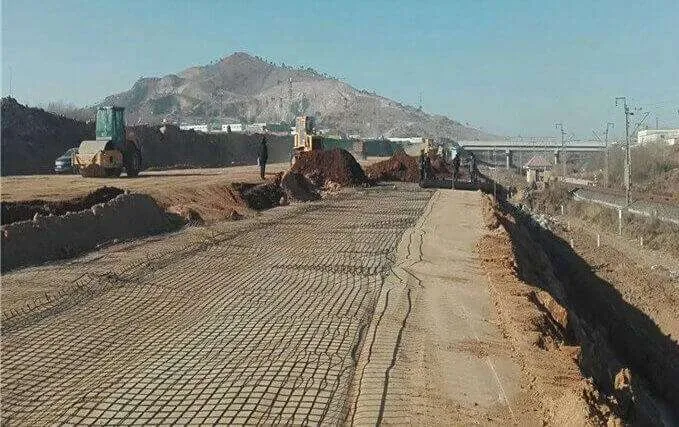
Recommended Products
High-Strength PET Woven Geotextile
High-strength woven PET geotextiles are particularly suitable for large embankments and soft-soil reinforcement where high tensile strength and controlled long-term deformation are required.
PET Geogrid
PET geogrid is another important reinforcement material for embankments, slopes and reinforced soil structures.Polyester reinforcement is especially useful where long-term tensile performance and creep behavior are important design considerations.
For permanent reinforcement structures, designers should evaluate the long-term design strength after considering creep, installation damage, chemical durability and other applicable reduction factors.
Related products: PET Geogrid · High-Strength Woven Geotextile
Common industries: Transportation · Mining · Site Development · Ports
4. Separation & Filtration
Separation and filtration are closely related but technically different functions.Separation prevents two different soil or aggregate layers from mixing.Filtration allows water to pass through a geotextile while retaining the required soil particles.
A geotextile under a road, for example, may perform both functions at same time.
Typical Applications
- Road subgrades
- Railway ballast
- Drainage trenches
- French drains
- Embankments
- Retaining walls
- Coastal structures
- Riprap systems
- Landfill drainage
- Reservoir liner protection
Recommended Products
Nonwoven Geotextile
Needle-punched nonwoven geotextiles provide high permeability and are widely used for filtration, drainage, separation and protection.
Woven Geotextile
Woven geotextiles offer higher tensile strength and lower elongation and are frequently selected where separation must be combined with stabilization or reinforcement.
The correct filter must allow adequate water flow without unacceptable soil migration or long-term clogging.
Related products: Nonwoven Geotextile · Woven Geotextile · PP Geotextile · PET Geotextile
Common industries: Transportation · Water · Waste · Mining · Coastal Engineering
5. Drainage Systems
Water and gas management can be same important as containment.Excess groundwater, leachate or gas pressure can reduce soil stability or create additional loading on a barrier system.Geosynthetic drainage systems provide a lightweight alternative or supplement to conventional granular drainage layers.
Typical Applications
- Landfill leachate collection
- Landfill gas drainage
- Heap leach pads
- Tailings facilities
- Retaining walls
- Tunnel and foundation drainage
- Reservoir underdrain systems
- Roadside drainage
- Green roofs
Recommended Products
HDPE Geonet
Geonets provide an in-plane flow path for liquids or gases.
Geocomposite Drainage
A drainage geocomposite typically combines a geonet drainage core with one or two geotextile layers.
The geonet provides transmissivity while the geotextile performs filtration and helps prevent soil particles from entering the drainage core.
This combination can reduce the volume of conventional drainage aggregate required in suitable applications.
For buried systems, long-term transmissivity under expected field loading is often more meaningful than initial flow capacity.
Related products: HDPE Geonet · Drainage Geocomposite · Nonwoven Geotextile
Common industries: Waste · Mining · Transportation · Water · Site Development
6. Reinforced Walls & Slopes
Steep slopes and mechanically stabilized earth structures rely on reinforcement to transfer tensile forces through the soil mass.
Geosynthetic reinforcement can allow engineers to construct steeper slopes and reinforced soil structures while improving stability.
Recommended Products
PET Geogrid
PET geogrids provide high tensile strength with relatively low creep and are widely used for long-term soil reinforcement.
Uniaxial Geogrid
Where the principal tensile load acts predominantly in one direction, uniaxial reinforcement may be appropriate.
High-Strength Woven Geotextile
High-strength woven geotextiles can also be used for reinforced soil slopes and embankments depending on the design requirements.
Typical Applications
- Reinforced soil walls
- Steep slopes
- Bridge approach embankments
- Highway embankments
- Mining infrastructure
Related products: PET Geogrid · PP Geogrid · High-Strength Woven Geotextile · Drainage Geocomposite
Common industries: Transportation · Mining · Site Development
7. Dewatering & Sludge Management
Projects involving sludge, sediment or fine solids often need to remove water while retaining solid particles.
Geotube dewatering systems provide a practical solution by combining containment and filtration in a single system.
How Does Geotube Dewatering Work?
Sludge or slurry is pumped into the geotextile tube.Water passes through the engineered textile while solids are retained inside. As dewatering progresses, the retained material consolidates and its volume decreases.
Typical Applications
- Wastewater sludge
- Mining sludge
- Dredged sediment
- Industrial sludge
- Lagoon cleaning
- River and canal dredging
- Aquaculture sludge
Related products: Geotube · Filtration Geotextile
Common industries: Mining · Wastewater · Water · Aquaculture · Dredging
8. Surface Erosion Control & Vegetation Support
Rainfall, runoff and flowing water can progressively remove exposed soil from slopes, channels and embankments.
Where vegetation is part of the long-term erosion-control strategy, a three-dimensional vegetation mat can provide temporary surface stabilization while helping vegetation establish.
Recommended Products
3D Vegetation Mat
The three-dimensional structure helps retain soil and provides a matrix through which vegetation can develop.
Geotextile
Geotextiles may provide additional filtration and separation underneath riprap or other erosion-control systems.
Geogrid
Where erosion is accompanied by deeper soil instability, reinforcement may also be required.
Typical Applications
- Highway slopes
- Railway embankments
- Riverbanks
- Drainage channels
- Landscaping
- Reservoir banks
- Reclaimed land
A vegetation mat is primarily a surface erosion-control material. It should not be used as a substitute for structural reinforcement where global slope stability is inadequate.
Related products: 3D Vegetation Mat · Geotextile · Geogrid
Common industries: Transportation · Water · Landscaping · Site Development
9. Composite Geosynthetic Systems
The greatest engineering value of geosynthetics often comes from combining several materials rather than selecting one product in isolation.
For example:
Landfill Liner System
Subgrade → GCL → HDPE geomembrane → nonwoven protection geotextile → drainage geocomposite → waste
Functions:
Barrier + Protection + Drainage
Mining Process Pond
Prepared subgrade → protection geotextile → HDPE geomembrane → drainage/leak-detection layer
Functions:
Containment + Protection + Drainage
Road Over Weak Subgrade
Weak soil → separation geotextile → geogrid → aggregate base
Functions:
Separation + Stabilization + Reinforcement
Reinforced Embankment
Soft foundation → woven geotextile/PET geogrid reinforcement → engineered fill → drainage system
Functions:
Reinforcement + Separation + Drainage
Aquaculture Pond
Prepared subgrade → protection geotextile where required → HDPE or LLDPE geomembrane
Functions:
Containment + Protection
This system-based approach allows the geosynthetic materials to perform complementary functions instead of expecting one product to solve every engineering problem.
From Project Requirements to Material Selection
When requesting a geosynthetic recommendation, providing only a product name is often not enough.
For more accurate material selection, send us:
- Project type — landfill, road, reservoir, mine, pond, slope, drainage system, etc.
- Project drawing or dimensions
- Soil and site conditions
- Required engineering function
- Existing material specification, if available
- Required standards
- Estimated project quantity
- Project country and delivery destination
Based on this information, Planetliner can help identify suitable geosynthetic product options, specifications, roll dimensions and material quantities for further engineering and procurement evaluation.
Geosynthetic Solutions by Industry
The same geosynthetic product can perform different functions in different industries.For this reason, engineering application and industry should be considered together.
| Industry | Common Engineering Requirements | Typical Geosynthetic Systems |
|---|---|---|
| Water | Seepage control, filtration, erosion protection | Geomembrane + geotextile + drainage |
| Waste | Containment, leak collection, protection | HDPE geomembrane + GCL + geotextile + geocomposite |
| Mining | Chemical containment, drainage, reinforcement | HDPE geomembrane + geotextile + geonet + geogrid |
| Aquaculture | Pond containment and liner protection | HDPE/LLDPE geomembrane + geotextile |
| Transportation | Separation, stabilization, reinforcement, drainage | Geotextile + PP/PET geogrid + drainage geocomposite |
| Site Development | Stabilization, retaining structures, drainage | Geogrid + woven geotextile + drainage composite |
| Environmental Engineering | Barrier, filtration, dewatering | Geomembrane + GCL + geotextile + geotube |
Need Help Selecting Geosynthetics for Your Project?
If you are designing, constructing or sourcing materials for a geosynthetic project, send us your project drawing, application, dimensions, soil conditions and required specifications.
Our team can help you review the material requirements and identify suitable geosynthetic options for your project.
Send Your Project Drawing → Get a Geosynthetic Material Recommendation