
From Project Drawing to Water Filling: An Aquaculture Pond Lining Project in Indonesia

Indonesia aquaculture pond
This aquaculture pond project in Indonesia started with a project drawing.The customer firstly contacted us with the pond design and asked for help estimating the required geomembrane quantity,and let us to suggest the specification and thickness selection.
After the HDPE geomembrane was provided, the project moved to the construction stage in Indonesia. During geomembrane installation, the customer contacted us again with questions about welding parameters after some sections of the double-track weld showed incomplete bonding.We show some welding videos and the project eventually progressed to pond completion and water filling.
This case study follows the actual journey of the project:
Project Drawing → Quantity Estimation → Liner Selection → Material Supply → Site Installation → Welding Issue→ Water Filling
For the large aquaculture pond projects: Choosing the right geomembrane is only one part of the job. Planning, installation and seam quality also matter.
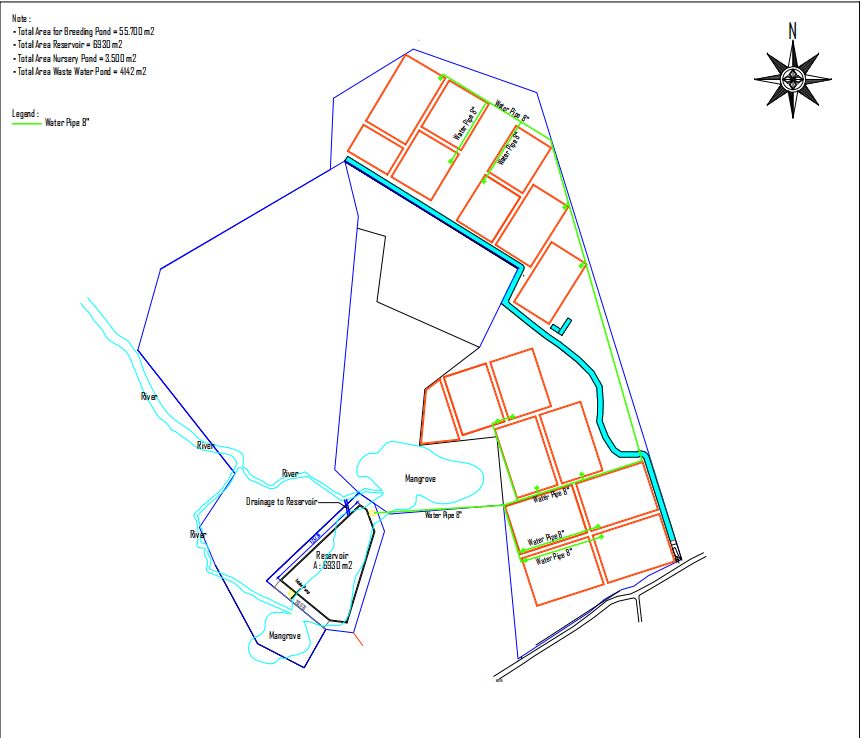
Indonesian aquaculture project design drawings
Indonesian aquaculture project design drawings
| Item | Project Information |
|---|---|
| Project Location | Indonesia |
| Application | Aquaculture Pond |
| Lining Material | HDPE Geomembrane |
| Customer Requirement | Quantity estimation and liner specification support |
| Installation | Performed on the project site |
| Technical Question | Double-track welding and incomplete bonding |
| Current Project Stage | Pond lined and filled with water |
1. The Project Began with a Pond Drawing
The first information we received from the Indonesian customer was not simply a request for the price of HDPE geomembrane.The customer shared the project drawing,which included the breeding pond,reservoir,nursery pond and waste water ponds.
The drawing showed the size of each pond clearly, and provided a much better starting point for discussing the pond liner requirement.For an aquaculture pond, the geomembrane does not cover only the horizontal bottom area. The liner must follow the actual shape of the pond.
Depending on the design, this can include:
- Pond bottom size
- Side slopes length and depth
- Upper edges
- Anchorage areas
- Overlap and welding allowances
The project drawing helped us understand the basic pond layout and estimate the liner requirement more accurately.For engineering and aquaculture projects, a drawing can often provide more useful information than a simple statement such as: We need 10,000 square meters of geomembrane.
The actual material requirement may be different once pond depth, slopes and liner layout are considered.
Why this matters for pond liner buyers?
A customer may know the total land area of a pond but maybe donot know the actual geomembrane quantity required.
This is particularly common in:
- Fish farming projects
- Shrimp ponds
- Aquaculture facilities
- Irrigation ponds
- Water reservoirs
For these applications, quantity estimation should consider the complete lining surface rather than only the pond bottom.
2. Estimating the Geomembrane Quantity
After receiving the pond drawing, we started to estimate how much geomembrane would be used.The purpose was not simply to produce a square-meter figure,we should consider the installation too.For example:
- How would the geomembrane cover the pond slopes?
- How would the material be arranged on site?
- How could the liner layout reduce unnecessary waste?
These questions are important because geomembrane is normally supplied in rolls or prefabricated sheets, while the pond itself has a specific three-dimensional shape.A practical quantity estimate may therefore involve consideration of:
- Pond dimensions
- Side slopes
- Depth
- Liner extension
- Welding overlaps
- Roll width
- geomembrane layout
The final quantity should always be confirmed according to the actual project design and installation plan.However, reviewing the drawing before ordering material can help the customer to avoid a common problem:Buying geomembrane based only on an approximate pond area and discovering later that additional material is needed.
According to client drawing and discussion, the project use about 94485sqm geomembrane liner.
3. The Next Question: What HDPE Geomembrane Thickness Was Suitable?
This is one of the most common questions in aquaculture pond lining projects.Customers often ask:What thickness of geomembrane liner should I use?
There is no single answer that applies to every pond. For this type of project, thickness selection needs to be considered together with the application and construction conditions.
Relevant factors can include:
- Pond design
- Subgrade condition
- Installation method
- Potential mechanical damage
- Equipment used around the pond
- Expected operating conditions
- Required durability
- Protection layers used within the lining system
It is easy to recommend the thickest possible geomembrane,but it is necessary to select a liner specification appropriate for the project.This is why receiving the project information at the beginning was useful.The drawing helped move the discussion from:What is your cheapest HDPE geomembrane price?
to: What liner solution is suitable for this particular pond?
For a more detailed discussion of liner selection, see our Geomembrane Thickness Guide.
For this Indonesia project, the client finally confirm the 0.5mm thickness liner,which is 100%virgin material, UV resistant.
4. From Material Planning to Project Supply
After the project requirements and liner specification were discussed, client confirmed the PI and arranged the deposit, and after 7days production, HDPE geomembrane was deliveryed to the aquaculture pond project in Indonesia.
However, supplying the material did not mean the project was finished.This is an important difference between selling a product and supporting an engineering application. The geomembrane needed to be deployed over the pond surface and joined by the welding machine.
At this stage, some practical installation questions became important.For international projects, this situation is common.The material supplier may be located in one country, while the geomembrane is installed by a contractor or project team in another country.
As a result, new technical questions may arise after the material has arrived at the site.That is exactly what happened during this Indonesian project.
But as a professional geosynthetic supplier, we give advice before material delivery, and show them the installaiton process, the welding machines and accessories.The client bought two sets of hot wedge welding machines, and one set extrusion welding machine with some HDPE welding rod.

geomembrane installaion
5. The Installation Stage Created a New Challenge
When all the material were arrived, the customer started installing the HDPE geomembrane, they contacted us again.This time, the question was about welding.
The project used a double-track welding process for geomembrane seams.During installation, the customer found that some welding areas did not seam well.
In practical terms, parts of the seam were insufficiently welded. The customer shared site photos and welding photos, and asked about suitable welding parameters(welding temperatue). This was an important stage in the project because the quality of a geomembrane lining system depends on not only geomembrane itself,but also the geomembrane installation process.
6. Understanding the Double-Track Welding Issue
Double-track welding typically creates two parallel welds with a channel between them.This configuration can support specific seam testing procedures depending on the project requirements.In this project, the issue was not that every seam failed.The problem was that some sections showed incomplete bonding,photo as following.
This type of inconsistency can have several possible causes.The key point was not to immediately assume that there was one simple explanation.Instead, the welding conditions needed to be reviewed.We send our welding videos and welded area photos, and tell client our parameters for reference.The discussion focused on factors such as:
- Welding temperature
- Welding speed
- Welding pressure
- Equipment condition
- Geomembrane surface condition
- Site environment
- Trial welding

geomembrane welding
Why Temperature Alone Is Not the Answer
One common reaction when a geomembrane weld is insufficient is:Increase the temperature.
But that is not always the correct solution.
HDPE geomembrane welding depends on the relationship between several variables.For example, welding speed and temperature influence each other.
Pressure and equipment condition can also affect the consistency of the seam.Environmental conditions,site wind and site temperaturemay change every day.
For this reason, we did not tell the client that there were one universal welding temperature that could solve every problem.The more appropriate approach was to review the actual welding conditions and verify the settings through trial welding.This is particularly important for field installation.
A parameter that works on one project may not automatically produce the same result on another project.
7. What Should Be Checked When Double-Track Welds Show Incomplete welding?
Welding Temperature
The temperature must provide sufficient heat for the geomembrane surfaces to fuse correctly.However, the correct setting depends on the material and actual site conditions.Simply copying a temperature from another project may not provide a reliable result.
Welding Speed
If the machine moves too quickly, the material may not receive sufficient heat.If it moves too slowly, excessive heating may occur.Temperature and speed should therefore be balanced together.
Pressure and Machine Condition
The welding machine must maintain suitable pressure and consistent operating conditions.The condition of components involved in the welding process should also be checked.Inconsistent equipment performance can contribute to inconsistent seam results.
Surface Preparation
The geomembrane surfaces must be suitable for welding.Dust, dirt, moisture or other contamination can affect welding.
This is particularly relevant for large outdoor pond projects where wind and site activity may introduce contaminants onto the liner surface.
Trial Welding
Trial welding is one of the most important steps.Instead of immediately beginning full production welding with assumed settings, trial seams can be used to evaluate whether the selected parameters are workable under actual site conditions.
This process should also be repeated when conditions change significantly.
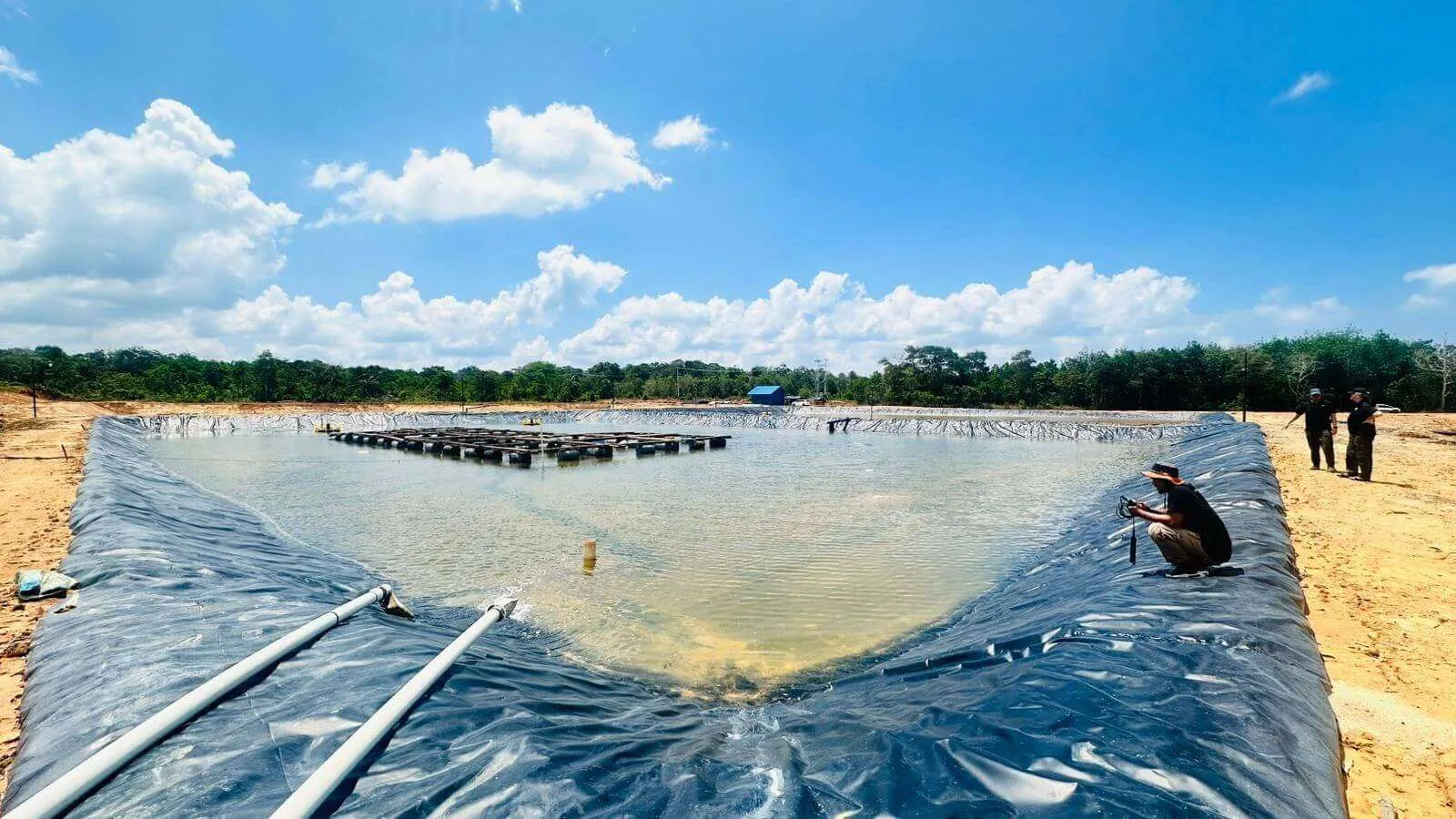
8. From Installation to Water Filling
After the installation stage, the project was nearly finished.The completed aquaculture pond was lined with geomembrane and later filled with water,photo for check.
For us, the final water-filled pond represented more than the delivery of geomembrane.It represented the completion of a longer process that had started with a project drawing.
The journey was:
Customer Drawing
↓
Geomembrane Quantity Discussion
↓
Liner Specification and Thickness Selection
↓
Material Supply
↓
Field Installation
↓
Welding Questions
↓
Project Completion and Water Filling
This is the actual path followed by many engineering projects.The purchase order is only one point in the process.
Have an Aquaculture Pond Drawing?
If you are planning an aquaculture pond, fish farm, shrimp pond or water containment project, you can share your available project information with us.
Useful information may include:
- Pond drawing
- Pond dimensions
- Application
- Site conditions
- Required liner area
- Planned installation method
Based on the available project information, we can discuss factors such as:
- Estimated geomembrane quantity
- HDPE or other material options
- Thickness considerations
- Roll dimensions
- Basic installation considerations
A project drawing can often provide a better starting point than asking only for the price of geomembrane.
Recent Post
Aquaculture Pond Lining in Indonesia | From Design to Installation
From Project Drawing to Water Filling: An Aquaculture Pond Lining Project in Indonesia This aquaculture pond project in Indonesia started with a project drawing.The customer firstly contacted us
When Is Geotextile Really Necessary?
When Is Geotextile Really Necessary in Civil Engineering Projects? Geotextiles are widely used in modern infrastructure and environmental engineering. However, a common question among engineers, designers, and contractors is: Is geotextile always necessary? In
Woven Polypropylene Geotextile Manufacturer | Engineering Grade & Landscape Fabric
Woven Polypropylene Geotextile Manufacturer | Engineering Grade & Landscape Fabric By Planetliner — Manufacturer of High-Performance Woven PP Fabrics for Global Projects Woven polypropylene geotextile has become a fundamental material in civil engineering, environmental protection,