

Basal Reinforcement for Embankments over Soft Ground
Embankments constructed on soft clay, silt, peat or other low-strength foundations can become failure, lateral spreading, excessive settlement and construction instability. Basal reinforcement introduces a high-strength tensile layer near the base of the embankment to support the engineered soil system.It can help restrain lateral spreading and manage deformation, but it does not eliminate consolidation settlement in soft ground.
Planetliner supplies high-strength woven geotextiles and PET geogrids for engineered soil reinforcement. We can discuss material grades against your project specification, while foundation design and construction-stage approvals remain with the project engineer.
Quick Answer
PET geogrid and high-strength woven geotextile are commonly considered for basal reinforcement because permanent embankments may require high tensile capacity with controlled long-term deformation. Selection should be based on design tensile strength after applicable reduction factors, not ultimate tensile strength alone.
What Project Problems Does This Application Solve?
- Low foundation shear strength
- Lateral spreading of embankment fill
- Construction instability during staged filling
- Differential settlement
- Need for tensile load transfer across weak zones
- Long design life requiring creep-controlled reinforcement
Recommended Geosynthetic System
| Project Condition | Recommended Product | Primary Function | Selection Focus |
| Permanent embankment | PET geogrid | Tensile reinforcement | Creep and long-term design strength |
| Very high tensile demand | High-strength woven geotextile | Basal reinforcement | Seams, installation damage, strain |
| Shorter-term/selected stabilization cases | PP geogrid | Reinforcement/stabilization | Project-specific design requirements |
| Wet soft foundation | Reinforcement + drainage strategy | System performance | Pore pressure and construction staging |
How to Select the Right Materials
Start with the thickness and strength of the soft deposits, groundwater, embankment geometry, fill properties and loading sequence. Evaluate foundation stability, lateral spreading, settlement, reinforcement strain and anchorage. Construction can be critical because the foundation may have less strength before consolidation occurs.
Permanent reinforcement is selected using long-term design strength, rather than ultimate tensile strength alone. Relevant assessments account for creep, installation damage and environmental durability. The design method also determines the applicable safety or resistance factors. PET selection should include the expected chemical environment and temperature, particularly where aggressive fills are proposed.
Design for the construction stages and service life
Start with the thickness and strength of the soft deposits, groundwater, embankment geometry, fill properties and loading sequence. Evaluate foundation stability, lateral spreading, settlement, reinforcement strain and anchorage. Construction can be critical because the foundation may have less strength before consolidation occurs.
Permanent reinforcement is selected using long-term design strength, rather than ultimate tensile strength alone. Relevant assessments account for creep, installation damage and environmental durability. The design method also determines the applicable safety or resistance factors. PET selection should include the expected chemical environment and temperature, particularly where aggressive fills are proposed.
Basal reinforcement may form part of a scheme with staged construction or ground improvement. It should not be described as a direct replacement for vertical drains, piles or soil treatment without comparing the complete engineered alternatives.
Plan continuity before ordering rolls
The principal strength direction, roll width, required lengths and construction access affect the material schedule. An overlap that is adequate for separation is not automatically a tensile connection. Load-carrying seams or joints require an approved detail and evidence of adequate strength.
During installation, protect reinforcement from dragging damage and uncontrolled vehicle movement. Inspect the first fill placement carefully. Monitoring may include settlement, lateral movement and pore pressure, with project-specific hold points before further loading.
When comparing suppliers, confirm whether quoted properties are typical, minimum or another specified statistical basis. Ask for the same testing conditions and reduction-factor evidence so apparently similar grades can be compared meaningfully.
Typical Industries and Projects
This application is commonly relevant to: Transportation; Mining; Site Development; Energy.
The exact material system should be matched to the engineering function, site conditions, design life and project specification.
Project / Case Reference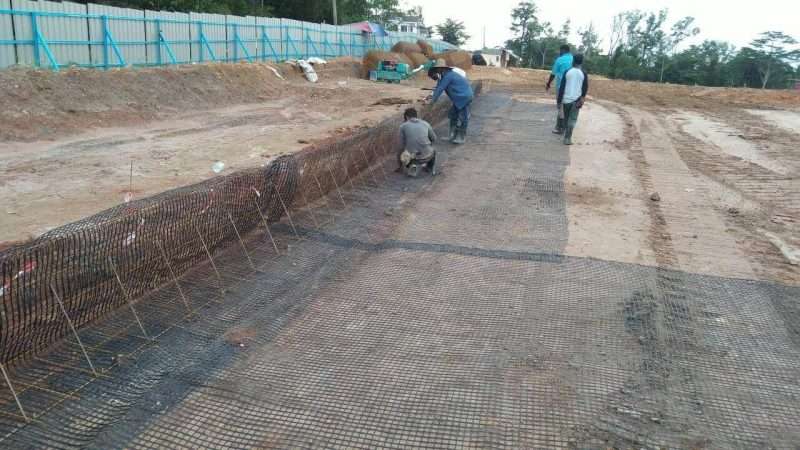

Example: for a road embankment over soft clay, a high-strength PET geogrid or woven geotextile can be placed at the base before controlled fill placement. The reinforcement provides tensile resistance while staged construction and drainage measures manage foundation response. Product strength and roll orientation must match the principal design load direction.
Frequently asked questions
What is basal reinforcement?
It is a tensile reinforcement layer installed near the base of an embankment to improve stability when the foundation soil cannot safely carry the imposed loading on its own.
Which is preferable PET geogrid or woven geotextile?
Both can be used for basal reinforcement. The choice depends on required design strength, strain behavior, soil interaction, seam requirements, installation conditions and the engineer’s design method.
Why is creep important?
Permanent reinforcement carries load for years or decades. Polymer deformation under sustained load must therefore be considered when deriving long-term design strength.
Does stronger reinforcement always solve soft-ground problems?
No. Foundation bearing capacity, acceptable settlement, drainage and construction timing can control the solution. Increasing nominal tensile strength alone may not address the governing failure mechanism.
Related Products, Industries & Solutions
Related solutions: Subgrade Stabilization; Reinforced Walls & Slopes; Drainage Systems.
Related products: PET Geogrid; High-Strength Woven Geotextile.
Discuss Your Project with Planetliner
Send your project drawing, application, dimensions, soil or slurry conditions, required engineering function, existing specification and destination. Planetliner can help identify suitable geosynthetic material options, specifications and quantities for further engineering and procurement evaluation.
CTA: Send Your Project Requirements → Get a Geosynthetic Material Recommendation