

Geosynthetic Erosion Control for Slopes and Vegetation Establishment
Surface erosion can remove soil from slopes, embankments, channels and riverbanks before vegetation becomes established. Geosynthetic erosion-control materials protect the surface, retain soil and support vegetation, while geotextiles and geogrids can provide filtration or deeper reinforcement where the problem extends beyond surface erosion.
Planetliner supplies 3D vegetation mats, geotextiles and reinforcement materials for defined engineering functions. Selecting the right combination starts with identifying whether the problem is surface soil loss, concentrated flow, soil migration or deeper instability.
Quick Answer
A 3D vegetation mat is suitable where the objective is to reduce surface soil loss and support vegetation establishment. Geotextile can provide filtration beneath riprap or armor layers. If the slope has a global stability problem rather than surface erosion alone, structural reinforcement such as geogrid may be required.
What Project Problems Does This Application Solve?
- Rainfall erosion on newly formed slopes
- Runoff channels cutting exposed soil
- Riverbank or shoreline soil loss
- Loss of topsoil before vegetation establishes
- Need for filtration beneath riprap
- Confusion between surface erosion and structural slope instability
Recommended Geosynthetic System
| Project Condition | Recommended Product | Primary Function | Selection Focus |
| Vegetated slope | 3D vegetation mat | Surface erosion control | Slope, runoff and vegetation |
| Riprap/stone protection | Nonwoven geotextile | Filtration + separation | AOS, puncture, hydraulic conditions |
| Reinforced steep slope | Geogrid + erosion mat | Reinforcement + surface protection | Global stability and facing |
| Channel/riverbank | Geotextile/erosion system | Filtration + erosion control | Flow velocity and anchorage |
How to Select the Right Materials
On a newly formed slope, raindrop impact and shallow runoff can remove soil before vegetation becomes established. In a channel, concentrated flow can impose much greater hydraulic demand. Along a riverbank, changing water levels, currents and toe scour introduce further risks.
These conditions should not receive the same blanket material recommendation. Establish the slope geometry, runoff route, soil type, expected vegetation and hydraulic exposure before selecting a mat. Evaluate structural stability separately where there are cracks, movement or evidence of deeper failure.
| Material | Intended role | Limitation to check |
|---|---|---|
| 3D vegetation mat | Retain surface soil and provide a matrix for vegetation | Suitability for the slope, exposure and expected flow |
| Nonwoven geotextile | Filter beneath specified armor or drainage materials | Not automatically suitable as an exposed vegetated surface |
| PET geogrid | Structural reinforcement within an engineered soil mass | Requires a separate reinforcement design |
| Woven geotextile | Selected filtration, separation or reinforcement duties | Construction type alone does not establish erosion-control performance |
Typical Industries and Projects
This application is commonly relevant to: Transportation; Water; Coastal & Waterways; Site Development.
The exact material system should be matched to the engineering function, site conditions, design life and project specification.
Review performance before ordering
For the mat, request product construction, thickness, mass, strength and relevant durability information. Where hydraulic resistance is claimed, request evidence identifying the tested system and conditions, including whether vegetation was established. Unvegetated and vegetated performance are different design situations.
Consider soil fertility, climate, season and access for watering or maintenance. A mat cannot create vegetation where seed selection, moisture or growing conditions are unsuitable. Compare the installed system, including soil preparation, anchors, overlaps, seed and establishment work.
Where a slope also needs tensile reinforcement, review reinforced walls and slopes. Where soil is being lost through stone protection, review geotextile filtration.
Installation and early maintenance
Grade the surface, remove protrusions and prepare the specified topsoil or seedbed. Lay the mat in close contact with the ground so runoff cannot easily pass beneath unsupported areas. Use the approved anchor trenches, fixing pattern and overlap arrangement for the slope and flow direction.
Do not adopt one universal pin spacing for every site. Anchorage depends on soil strength, slope geometry, runoff and the selected product. Complete infilling, seeding and watering according to the intended vegetation system.
Inspect after significant rainfall and during establishment. Repair undercut edges, displaced mats, concentrated-flow channels and bare areas promptly. Maintain upstream runoff controls; diverting concentrated water can be as important as protecting the slope face.
Typical Industries and Projects
This application is commonly relevant to: Transportation; Water; Coastal & Waterways; Site Development.
The exact material system should be matched to the engineering function, site conditions, design life and project specification.
Project / Case Reference
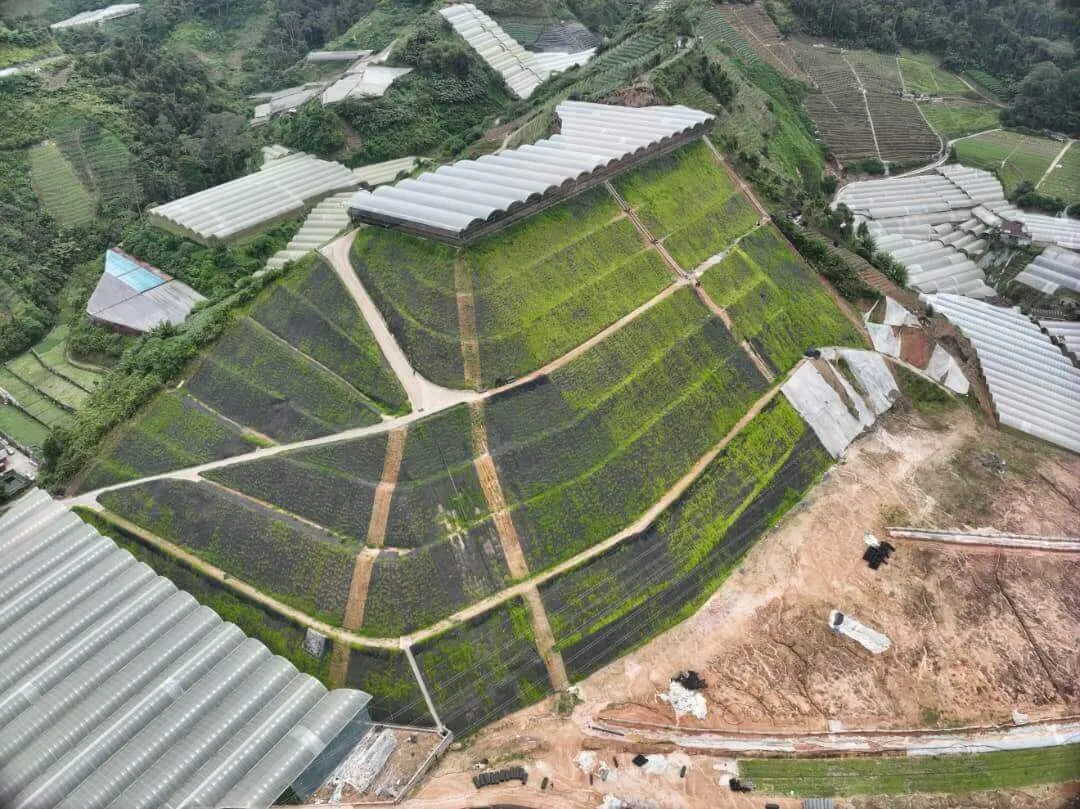
Example: This is an application of vegetation netting in Malaysia; the structure is 50 meters high, with a greenhouse at the top used for growing chrysanthemums.
Related uses include transportation slopes, water infrastructure, mine rehabilitation and energy-site earthworks.
Review performance before ordering
For the mat, request product construction, thickness, mass, strength and relevant durability information. Where hydraulic resistance is claimed, request evidence identifying the tested system and conditions, including whether vegetation was established. Unvegetated and vegetated performance are different design situations.
Consider soil fertility, climate, season and access for watering or maintenance. A mat cannot create vegetation where seed selection, moisture or growing conditions are unsuitable. Compare the installed system, including soil preparation, anchors, overlaps, seed and establishment work.
Where a slope also needs tensile reinforcement, review reinforced walls and slopes. Where soil is being lost through stone protection, review geotextile filtration.
Installation and early maintenance
Grade the surface, remove protrusions and prepare the specified topsoil or seedbed. Lay the mat in close contact with the ground so runoff cannot easily pass beneath unsupported areas. Use the approved anchor trenches, fixing pattern and overlap arrangement for the slope and flow direction.
Do not adopt one universal pin spacing for every site. Anchorage depends on soil strength, slope geometry, runoff and the selected product. Complete infilling, seeding and watering according to the intended vegetation system.
Inspect after significant rainfall and during establishment. Repair undercut edges, displaced mats, concentrated-flow channels and bare areas promptly. Maintain upstream runoff controls; diverting concentrated water can be as important as protecting the slope face.
Frequently Ask Questions
Is a 3D vegetation mat the same as geogrid?
No. A vegetation mat mainly supports surface erosion control and vegetation. Geogrid is primarily a reinforcement or stabilization product.
Can geotextile stop riverbank erosion?
Geotextile can act as a filter beneath riprap or other armor, but it is usually one component of a hydraulic erosion-control system rather than the exposed armor itself.
How do I know if a slope needs reinforcement instead of an erosion mat?
If the concern is global instability, deep-seated movement or inadequate factor of safety, a geotechnical stability assessment is required. Surface mats address erosion, not structural failure.
Can installed erosion-control mats be reused or recycled?
Reuse depends on damage and whether removal is compatible with the design. Recycling depends on polymer type, contamination and local facilities. Do not promise that a soil-filled, rooted mat can be recovered or recycled easily.
Related Products, Industries & Solutions
Related solutions: Reinforced Walls & Slopes; Separation & Filtration; Drainage Systems.
Related products: 3D Vegetation Mat; Geotextile; Geogrid.
Discuss Your Project with Planetliner
Send your project drawing, application, dimensions, soil or slurry conditions, required engineering function, existing specification and destination. Planetliner can help identify suitable geosynthetic material options, specifications and quantities for further engineering and procurement evaluation.
CTA: Send Your Project Requirements → Get a Geosynthetic Material Recommendation