
Geogrid for Retaining Walls: A Complete Guide with PET Geogrid Projects in Malaysia
Retaining walls are essential in civil engineering for holding back earth, stabilizing slopes, and creating usable land in uneven terrains. Building strong, stable retaining walls is essential in modern construction and infrastructure projects. Whether for road embankments, hillside developments, or landscaping, retaining walls help prevent soil erosion, landslides, and collapse.
However, as wall height increases or soil becomes weaker, simple concrete or gravity structures may not be enough. As a manufacturer and exporter of geogrid for retaining walls, we will tell you when and how to use geogrid for retaining walls, focusing on PET geogrid applications and show you a real Malaysian project case study.
What Is a Geogrid for Retaining walls and Why Is It Important ?
A geogrid for retaining walls is a high-strength polymer mesh made from materials such as polyester (PET), polypropylene (PP), or high-density polyethylene (HDPE).It is used to reinforce soil, allowing walls and slopes to bear greater loads safely and efficiently.
When used behind a retaining wall, the geogrid creates a reinforced soil mass, combining the strength of the soil and the tension of the geogrid to resist lateral earth pressures.
Key Benefits of Using Geogrid for Retaining Walls
Improved structural stability
Resistance to rainfall and erosion
Reduced construction cost and wall thickness
Enhanced performance on soft or weak soil
Eco-friendly and long-lasting system
When Should You Use Geogrid Reinforcement?
Not every wall requires geogrid, but certain conditions make it essential. Here are the most common triggers:
| Condition | Why It Matters |
|---|---|
| High wall height (≥ 3 m) | Lateral earth pressure increases nonlinearly; geogrid helps resist it. |
| Weak or compressible backfill soil | Prevents wall movement and settlement. |
| Surcharge loads (traffic, structures, storage) | Distributes load evenly into the soil mass. |
| Wet climate or poor drainage | Reduces hydrostatic pressure and erosion. |
| Limited construction space | Allows thinner walls with smaller foundations. |
In short:
If your retaining wall is tall, loaded, or built on poor soil — geogrid is not optional, it becomes necessary.
Types of Retaining Walls and How Geogrid Works
Gravity walls:
Simple, rely on weight — geogrid usually not needed.Cantilever concrete walls:
May use geogrid in the backfill to reduce bending pressure.Segmental retaining walls (SRWs):
Modular block systems reinforced with layers of geogrid — the most common use case.Reinforced soil slopes (RSS):
Steep vegetated slopes stabilized by geogrid and facing panels or mats.
PET Geogrid — The Preferred Choice for Retaining Walls
Among all geogrid materials, PET geogrid (Polyester geogrid) is particularly suited for retaining walls.
1. High Tensile Strength
PET geogrid offers exceptional tensile strength, often ranging from 40 kN/m to over 200 kN/m, allowing it to withstand high stresses.
2. Excellent Creep Resistance
PET maintains long-term strength under sustained loads — crucial for walls supporting continuous pressure.
3. Chemical Stability
It resists chemical attack, UV degradation, and biological effects in various soil conditions.
4. Dimensional Stability
PET geogrid maintains shape and stiffness under tension, preventing deformation or slippage.
5. Cost Efficiency
Compared with steel reinforcement or heavy concrete walls, PET geogrid systems significantly reduce overall cost.
Case Study: PET Geogrid Retaining Wall Project in Malaysia
Project Overview
Location: Selangor, Malaysia
Application: Highway slope stabilization and retaining wall
Wall height: 5-10 meters
Geogrid used: Uniaxial PET geogrid, 60/30kN,80/30kN,and 100/30 kN/m tensile strength
Engineering Challenges
High rainfall and water accumulation behind wall
Weak subgrade soil and limited space
Heavy traffic surcharge load from nearby highway
Project Results
Wall deformation < 10 mm after monsoon season
No water pressure buildup due to effective drainage
Construction time reduced by 30% compared with cast-in-place wall
Maintenance-free after 2 years of operation

Conclusion:
PET geogrid proved to be the perfect reinforcement choice for retaining walls in tropical Malaysia — durable, cost-effective, and eco-friendly.
Design Principles for Geogrid Retaining Walls
When designing a geogrid-reinforced wall, engineers must consider:
Geogrid Length (L):
Typically 0.6–0.8 × wall height to ensure stability.Vertical Spacing:
Commonly 40–60 cm; closer spacing improves stiffness.Pullout Resistance:
Check bond strength between soil and geogrid (τ × L × embedment depth).Facing Connection:
Geogrid must be securely connected to block or panel facings.Drainage Design:
Always include weep holes, gravel layers, and perforated pipes.Safety Factors:
Standard design safety factors:Sliding ≥ 1.5
Overturning ≥ 2.0
Bearing capacity ≥ 3.0
Installation Guide for Geogrid Retaining Walls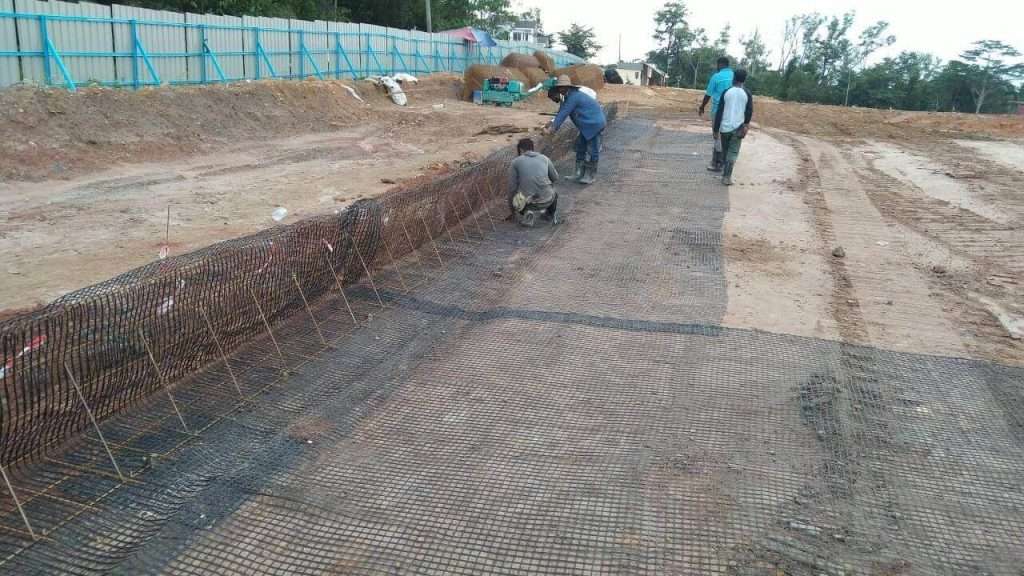
Follow these best practices for long-term stability:
Prepare a level, compacted foundation.
Place the first layer of modular blocks or facing panels.
Roll out the geogrid perpendicular to the wall face.
Tension geogrid to remove wrinkles.
Overlap rolls (≥ 300 mm) if required.
Place and compact granular backfill in 150–200 mm lifts.
Repeat layering until desired wall height is reached.
Ensure drainage pipes and filter materials are installed.
Avoid heavy machinery directly on the geogrid surface.
Tip: Always follow manufacturer guidelines for anchorage and connection details — small mistakes in overlap or alignment can reduce performance by 30%.
Maintenance and Longevity
PET geogrid retaining walls require minimal maintenance if built correctly:
Check drainage outlets regularly.
Inspect wall face for cracks or displacement.
Control vegetation near drainage lines.
Under normal conditions, PET geogrid structures can last over 75 years, offering exceptional long-term performance.
Environmental Benefits
Geogrid-reinforced walls consume less concrete and steel, reducing carbon footprint.
They also allow for vegetated facings, improving local aesthetics and biodiversity — perfect for green urban designs or eco-friendly highways.
Frequently Asked Questions (FAQ)
Q1: How long will a geogrid retaining wall last?
A: PET geogrids are designed for 25–50 years of service life under standard environmental conditions.
Q2: How many layers of geogrid are needed?
A: Typically, one layer every 0.4–0.6 m in height. The exact number depends on wall height and load.
Q3: Can I use geogrid for small garden walls?
A: Yes. Even 1–2 m landscape walls can benefit from lightweight geogrid reinforcement.
Q4: Is PET geogrid better than PP or HDPE?
A: PET performs better in creep and long-term strength, making it ideal for permanent retaining structures.
Q5: What is the cost of a geogrid retaining wall?
A: Costs vary by material, wall height, and location. On average, it’s 20–40% cheaper than a fully cast concrete wall.
Conclusion
Using geogrid for retaining walls is one of the most effective and sustainable engineering solutions for soil stabilization.
With PET geogrid reinforcement, walls can be built taller, safer, and more economically — even under challenging tropical conditions like those in Malaysia.
The success of Malaysia’s PET geogrid retaining wall project proves that this technology not only enhances safety but also supports greener, more resilient infrastructure for the future. If you have any question about the retaining walls, feel free to contact our engineers,and follow our Linkedin Facebook Youtube Pinterest for more details!
Recent Post
Aquaculture Pond Lining in Indonesia | From Design to Installation
From Project Drawing to Water Filling: An Aquaculture Pond Lining Project in Indonesia This aquaculture pond project in Indonesia started with a project drawing.The customer firstly contacted us
When Is Geotextile Really Necessary?
When Is Geotextile Really Necessary in Civil Engineering Projects? Geotextiles are widely used in modern infrastructure and environmental engineering. However, a common question among engineers, designers, and contractors is: Is geotextile always necessary? In
Woven Polypropylene Geotextile Manufacturer | Engineering Grade & Landscape Fabric
Woven Polypropylene Geotextile Manufacturer | Engineering Grade & Landscape Fabric By Planetliner — Manufacturer of High-Performance Woven PP Fabrics for Global Projects Woven polypropylene geotextile has become a fundamental material in civil engineering, environmental protection,