
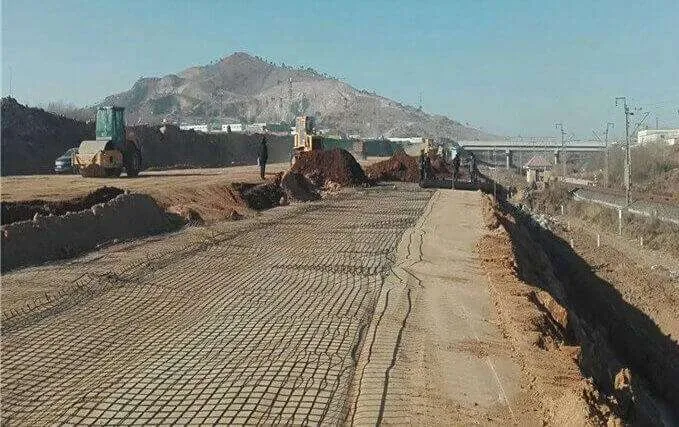
Geogrid for Road Construction and Soil Stabilization
A soil stabilization geogrid can help restrain movement of stone within a granular road layer under traffic. It works as part of a system that includes the ground beneath, the aggregate, drainage and the construction method. On a wet access road, choosing a roll before understanding why the road is failing can leave the contractor paying for the wrong solution.
This guide follows the decisions that affect a road stabilization order. It covers temporary access routes, permanent roads and busy industrial yards. The aim is to help contractors identify the problem, prepare a useful material enquiry and check the first installed area before committing the whole site to the same method.
Find out what is moving and where the water goes
A rut is a symptom. It may come from movement within the aggregate, deformation of the soil below or both. Mud appearing in the stone layer points to another issue: separation and filtration may need attention. A stronger grid does not answer all three problems by itself.
Walk the route and mark where the damage occurs. Is it concentrated at turning points, low areas, transitions or freshly excavated sections? Compare dry and wet conditions. Include the drainage route and outlet on the same sketch. This gives the project team a better starting point than a photograph of a single deep wheel track.
| What the contractor sees | Question to investigate | Possible response to evaluate |
| Stone pushes sideways at turns | Is the granular layer moving under traffic | Grid and aggregate system review |
| Mud enters the base | Are soil and stone intermixing | Suitable separation or filter fabric |
| Rutting worsens after rainfall | Is water weakening the formation | Drainage and ground condition review |
| A wide area settles over time | Is there deep compressible ground | Foundation and settlement assessment |
| Damage starts during first-cover placement | Is the construction method disturbing the ground | Revised placement and equipment plan |
For a wider overview of material functions, see subgrade stabilization. Here, the focus is the road contractor’s decisions from ground assessment through material delivery and early construction.
Separate temporary access from permanent road requirements
A temporary access road may need to carry heavy deliveries for a short construction period. Its first challenge is getting equipment onto weak ground without destroying the formation. The contract should still define acceptable rutting, maintenance and any later removal or incorporation into permanent works.
A permanent road needs an accepted pavement design for its traffic and ground conditions. Construction vehicles can also create a demanding early load case before the full pavement is in place. Check both stages instead of assuming that the final surfacing will correct damage caused during construction.
Industrial yards and loading areas bring concentrated movements at entrances, turning points and stopping locations. Those areas may need separate attention in the design and trial plan. A long straight test strip does not necessarily represent the way heavy vehicles will steer and brake beside a loading bay.
Put the grid and fabric in the right roles
PP biaxial geogrid is a common product route for review in granular stabilization. Its suitability depends on the specific product and the surrounding aggregate. Use the PP geogrid page for product construction and purchasing details.
Where fine soil can enter the base, the design may also require a geotextile. The grid restrains aggregate movement; the fabric performs the specified separation or filtration function. Confirm their position and connection details on the drawing. Do not remove the textile simply because the purchase order already contains a geosynthetic material.
For a fabric-focused selection, see the road geotextile guide. Keep two decisions separate: how to restrain movement within the aggregate, and how to stop fine soil entering that layer. Give each material its own requirement in the purchase schedule so neither function is overlooked.
If the problem is a raised embankment crossing deep soft deposits, refer the scheme for basal reinforcement and ground treatment assessment. Surface stabilization does not remove consolidation settlement deeper below the road.
Send ground and traffic information before asking for a grade
The material enquiry should include the project specification and any available ground investigation. A soil strength measure such as CBR may be part of that information. Explain whether the result represents dry, soaked or expected site conditions. A number without its condition can be misleading on a route that becomes wet during construction.
Describe the vehicles that will use the road, including construction equipment. Provide expected traffic, load information and the required performance criteria from the project. If these are still being developed, ask for a preliminary supply discussion and identify the unknowns.
| Information to send | Useful detail | Decision it supports |
| Ground investigation | Soil layers, strength and wet conditions | Whether shallow stabilization is appropriate |
| Traffic and equipment | Loads, movements and construction stage | Relevant loading and installation assessment |
| Aggregate | Grading, particle shape and source | Compatibility with the proposed grid |
| Road section | Layer arrangement and proposed thickness | Position of grid and any fabric |
| Water conditions | Groundwater, surface routes and outlets | Drainage provisions before covering |
| Performance requirement | Accepted rutting or pavement criteria | Design and trial acceptance |
This information does not need to arrive as a polished report for the first conversation. A marked plan, the issued specification and the available test results are more useful than a request for a universal heavy-duty grade.
Match the proposed grid to the actual aggregate
The openings need to be evaluated with the selected stone, not in isolation. Aggregate grading and particle shape influence the interaction. More tensile strength alone does not demonstrate that one grid will perform better than another in the proposed road section.
Ask how the product is accepted under the project’s design method. If the proposal relies on testing of a particular grid and aggregate arrangement, establish whether the conditions resemble your site. Changing the grid, stone source or layer arrangement can change the basis of the claim.
Be especially careful with a promised reduction in aggregate thickness. It should come from an accepted design comparison, not a standard sales percentage. Keep the original and proposed sections visible in the review so the contractor knows exactly what is changing and which evidence supports the change.
Make the first lift part of the purchasing discussion
The first aggregate layer is placed before the completed road can protect the grid and formation. On weak ground, that stage can determine whether the construction method is workable. Agree how material will be delivered, spread and compacted without unnecessary disturbance.
The approved method should define equipment access, cover requirements and joint treatment. Do not assume a universal overlap dimension is suitable for every ground condition. Temporary pins may help hold material in position, but they do not turn an overlap into an engineered tensile connection.
Keep vehicles off exposed geogrid. Spread fill using the approved sequence and avoid movements that drag the grid or push a wave of stone across it. If the formation pumps or the first layer deforms excessively, stop and review the cause before adding more material by habit.
Use a trial area to check constructability
A representative trial area can help confirm the proposed installation sequence and identify obvious construction damage or movement. Agree its location, size, observations and acceptance criteria with the project team before starting. Select a location that represents the difficult conditions, not only the firmest part of the route.
Record the formation condition, roll identity, aggregate source, placement method and equipment used. Observe whether joints move, wrinkles develop or the fill disturbs the ground. Where inspection of buried grid is required, plan how it will be exposed and reinstated under the approved procedure.
A satisfactory short trial is useful evidence of constructability. It is not proof of the entire design life of a permanent road. Keep those claims separate when comparing proposals or writing the completion record.
| Trial observation | Useful action | Record for later work |
| Grid moves while stone is spread | Review placement sequence | Revised approved method |
| Rutting exceeds the agreed limit | Investigate ground, water and layer behaviour | Measurements and review decision |
| Exposed ribs or junctions are damaged | Review aggregate and equipment conditions | Photographs and product identification |
| Fine soil contaminates the aggregate | Recheck separation and drainage | Accepted system detail |
Calculate quantity from the layout rather than a guess
Use the road or yard plan to determine the installed area. Add approved overlaps, end joints, turnouts and irregular sections separately. Show cutting and handling allowances clearly so the purchaser can distinguish a measured requirement from a provisional estimate.
For example, an illustrative 600 m route that is 6 m wide has a plan area of 3,600 m². If the approved roll layout adds 300 m² for joints and details, the calculated order basis becomes 3,900 m² before any separately agreed spare quantity. These figures illustrate measurement only; they do not recommend an overlap width or a standard waste allowance.
Match the delivery sequence to the work. If only one end of the route has access for unloading, a shipment of oversized rolls can slow the crew. Ask for dimensions and roll mass with the quotation, and confirm the equipment that will move them to the installation area.
Compare the complete road option
The grid price is only one part of the decision. Compare accepted options using aggregate supply and haulage, fabric if required, earthworks, installation, testing and the maintenance scope relevant to the contract. A low roll price is not a project saving if it leaves the approved section unchanged and adds unplanned work.
Consider an illustrative depot access road that fails near a wet entrance. One proposal simply increases grid strength. Another first checks the drain outlet, the muddy interface and the turning traffic, then submits a suitable grid and fabric arrangement for review. The second proposal is more useful because it addresses the observed causes and makes its assumptions visible.
The financial result for that depot would depend on quantities, local material costs and the accepted design. Ask for a priced comparison once those inputs are available, with each proposed change clearly identified.
Questions about geogrid road stabilization
Can geogrid be placed directly over mud
The formation and installation method need approval for the actual conditions. Very weak ground may need separation, drainage, different equipment or other treatment. Do not assume that a stronger roll makes unrestricted placement on saturated ground acceptable.
Is road grid also suitable inside asphalt
An aggregate stabilization grid and an asphalt reinforcement system serve different positions and requirements. Do not substitute the PP base grid into an asphalt layer. Refer the proposed asphalt application to its own product and installation specification.
Can I change the quarry after the product is approved
Submit the new aggregate information for review. Grading, shape and variability can affect the basis on which the system was accepted. Keep the substitution record with the material approval rather than treating the quarry change as a purchasing detail only.
What should I send to obtain a quotation
Send the road plan, specification, proposed layer arrangement, estimated area and destination. Include ground and aggregate reports where available, plus the installation programme. State whether you need a preliminary budget, an approval submission or a confirmed project order.
Request a road geogrid supply review
Planetliner supplies PP geogrid and related geotextiles for project buyers. We can discuss the material specification, roll arrangement and available documents for your review. The appointed engineering team approves the road design and any proposed changes.
Send your road project enquiry with a marked drawing and the latest requirement sheet. Include a short description of the problem on site. That gives the purchasing and technical teams a practical basis for comparing products and planning the first delivery.