

Polyester Geogrid Supplier for Reinforced Walls Slopes and Embankments
Polyester geogrid, also called PET geogrid, is a reinforcement material made from high-tenacity polyester yarns formed into an open grid and protected with a polymer coating. It is considered for reinforced soil walls, slopes and embankments when the selected grade and its supporting evidence meet the project design.
Planetliner supplies PET geogrid for contractors, importers and project buyers. Send the required tensile grade, strength direction, quantity and document schedule. We can review the proposed material and prepare a supply quotation around the specification rather than a product name alone.
Start with the required reinforcement function
A retaining wall reinforcement layer carries a different requirement from a grid used to restrain aggregate movement in a road base. The material structure, performance evidence and design method must suit the job.
PET geogrid is commonly considered where tensile reinforcement is required over a defined service period. Its suitability depends on the particular product, strain behaviour, fill, environment and available long-term evidence. The word polyester does not establish an acceptable design strength by itself.
For the wider product options, see our geogrid overview. For a wall purchase, our retaining wall geogrid guide explains the project information to prepare.
Understand uniaxial and biaxial grade descriptions
Machine direction, or MD, normally means along the roll. Cross direction, or CD, means across it. Always confirm the supplier’s direction convention and show the required roll orientation on the material schedule.PET grids can be produced with a dominant strength direction or with substantial strength in both principal directions. The roll label and drawing should make the load-carrying direction clear. Do not assume that every polyester grid is uniaxial or that every square opening means equal strength.
If a quotation describes a grade as 100/30 kN/m, ask the supplier to confirm which direction each number represents. In an agreed specification, those may be the machine and cross-machine tensile strengths. They are not the load the finished wall can carry, and they are not automatically the long-term values used in design.
This becomes practical when a contractor cuts panels from a roll. Rotating a panel to reduce waste can place the weaker direction along the design load. The saving disappears if the panel must be removed. Include a direction arrow on the approved cutting plan and on sample approval photographs.
Planetliner’s published PET data sheet includes the following uniaxial reference grades. Confirm the current data sheet, acceptance basis and production availability for the order.
| Published reference grade | MD tensile strength kN/m | CD tensile strength kN/m |
| UG60 | 60 | 30 |
| UG100 | 100 | 30 |
| UG200 | 200 | 30 |
| UG400 | 400 | 50 |
The public sheet identifies ASTM D6637 for the tensile values. A grade number is not a universal model designation across manufacturers. Compare the method, units, directions and declared value basis when reviewing another offer.
The published PET geogrid data sheet is a starting reference. Project-specific confirmation should identify the exact offered grade and any additional requirements.
Ultimate tensile strength and long term design strength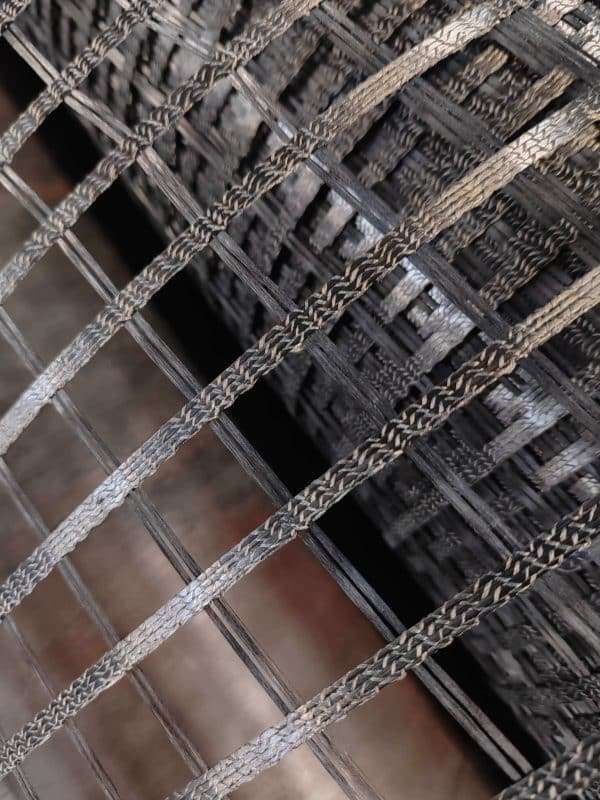

Ultimate tensile strength describes a short-term test result. Permanent reinforcement also needs to account for sustained loading, installation damage and environmental exposure. Creep is the gradual extension that can occur while a polymer carries a load over time. It is not a defect that disappears simply because the product is polyester.
The design method determines how the evidence is used. Ask the reviewer to identify the required design strength, design period and relevant conditions. The supplier should then identify the supporting data for the offered grade or explain the limits of the available evidence. A test on a different yarn system should not silently become proof for the proposed product.
ASTM D5262 addresses creep and creep rupture testing under sustained tension. It answers a different question from a short-term tensile test. Referencing either method does not establish that a particular Planetliner grade has completed every test required by your project.
| Item on a product offer | What the buyer needs to understand | What it does not prove alone |
| Ultimate tensile strength | Direction, method and declared value basis | Long-term design capacity |
| Strength at a stated strain | Load carried at that amount of extension | Acceptable movement of the whole structure |
| Creep information | Applicable product, load, time and temperature | Compatibility with every fill environment |
| Installation damage evidence | Fill and placement conditions represented | Survival under any construction method |
The black coating PVC or SBR
A protective coating helps protect the yarn structure during handling and installation. It does not make the grid immune to abrasion, chemicals or poor site practice. Two black grids may use different yarns, coatings and manufacturing controls. Appearance is useful for checking consistency, but it is not a substitute for identification.
Ask which coating is offered and whether that construction matches the submitted data. Check samples for visible broken yarns, uneven coverage and damaged junction areas. Agree which features are acceptable and which require investigation before a bulk order. A photograph can document workmanship; it cannot establish a design strength. We have PVC coating and SBR coating, and the PVC coating price is higher than SBR coating.
Suppliers may describe the structure as warp-knitted polyester geogrid, woven polyester geogrid or coated PET geogrid. These descriptions need checking against the actual product construction. State the required construction directly in the enquiry. If a tender calls for a welded product, do not assume a yarn-based grid is equivalent because both contain PET.
Match the product to the project
Reinforced retaining walls
Provide wall geometry, reinforcement lengths and spacing, facing details, fill properties, design tensile demands and the document requirements. Where reinforcement connects to a facing system, the connection needs evidence for the actual combination.
Do not choose the grid solely from wall height. Drainage, foundation conditions and the overall structure also affect the design. The material quotation should follow the approved reinforcement schedule.
Reinforced slopes
Provide slope geometry, fill and foundation information, intended design life, exposure and the reinforcement arrangement. Structural reinforcement and surface erosion protection perform different jobs. A grid buried in fill is not automatically a complete exposed-face protection system.
Embankments over soft ground
For basal reinforcement, identify the principal load direction, design strength, allowable strain and required continuity. The scheme may also need drainage, staged filling or other ground treatment. Reinforcement alone does not eliminate consolidation settlement.
Plan roll lengths around the reinforcement schedule
Reinforcement quantity is not the visible face area of a wall. Each buried layer has its own length and width. Several grades may be needed at different levels. Ask the contractor for a material schedule that follows the approved drawings, including corners and transitions.
Long rolls can be efficient for repeated panel lengths. They can also leave remnants that are too short for the next panel. For example, a hypothetical 100 m roll cut into eleven 9 m panels leaves 1 m before cutting losses. A different panel length changes that outcome. This is a cutting calculation, not a recommendation to use 9 m reinforcement.
Keep useful remnants identified by grade and direction. Do not create a load-carrying splice from short pieces unless the design explicitly permits and details it. Agree roll mass, unloading access and storage space so a theoretically efficient package remains workable on site.
For a mixed shipment, group rolls so crews can identify the material needed for the first construction stage. Ask whether the packing list can show the intended wall zone as well as the product grade. Keep those location notes separate from the permanent batch identification. If the construction sequence changes, the product identity must remain clear even when a roll moves to a different work area.
Before ordering spare material, review which approved panels can actually be cut from it. An extra area allowance is less useful if its roll dimensions leave pieces that cannot satisfy the required panel length.
What affects PET geogrid price
The quotation depends on tensile requirements in both directions, product construction, coating, roll dimensions, quantity and the required testing and inspection. Compare the same specification and delivery basis before deciding which supplier is less expensive.
A low unit price can be misleading if the offer excludes a required report or uses a different strength basis. Ask for the exceptions to your specification to be identified alongside the price. This makes technical review and purchasing easier to coordinate.
| Requirement | Useful information |
| Project | Retaining wall, slope, embankment or another defined use |
| Strength | Required values in both directions and the test method |
| Design evidence | Long-term requirements and the specified document list |
| Geometry | Approved reinforcement schedule and relevant drawings |
| Material order | Area, roll sizes, destination and target delivery date |
You can begin with the issued specification even if the final quantity is still being checked. Mark preliminary information clearly so that the quotation and the later order remain consistent.
Questions about PET geogrid supply
Is polyester geogrid always better than polypropylene
No universal ranking answers a project enquiry. PET is worth considering for specified tensile reinforcement, while PP grids are commonly evaluated for aggregate stabilization. Compare the evidence needed for the actual function. Our PP geogrid page explains that purchasing route.
Can the strength or roll size be customized
Send the required properties and dimensions for a feasibility review. A proposed custom grade still needs an agreed acceptance basis and the relevant supporting evidence. Availability, production quantity and lead time should be confirmed for that offer rather than assumed from a general customization statement.
Can the grid be used with any retaining wall block
The connection must be checked for the actual facing system. Matching a tensile figure does not demonstrate how the grid behaves where it meets the blocks. Provide the block details and the project requirements for connection evidence before approving a substitution.
What is the minimum information for an initial enquiry
Send the project country, application, required directional strengths, quantity and destination. Attach the specification and reinforcement schedule when available. Add required design-life evidence, fill conditions and approval deadlines so the commercial offer reflects the real procurement task.
Request a specification review and quotation
Send us your requirement,We will review the required grade, available documentation, dimensions and supply scope, then identify what needs confirmation before the material can be proposed for approval.