
What Geomembrane Welding Machine for Plastic Material?
When installing HDPE geomembranes in ponds, landfills, mining projects, or reservoirs, a geomembrane welding machine is needed and the most critical tool. High-quality welding ensures long-lasting seams, prevents leakage, and guarantees project safety.
Geomembrane welding machines are specialized equipment designed to join sheets of geomembrane, creating continuous, impermeable barriers essential for containment applications. These machines have become necessary in modern construction and environmental protection projects, ensuring the integrity of structures ranging from water reservoirs to waste containment facilities.
The choice of welding equipment significantly impacts installation efficiency, seam quality, and ultimately, the performance of the geomembrane system. Understanding the different types of welding machines, their optimal applications, and proper operation techniques is fundamental for project success.
1.Why Geomembrane Welding Machines Are Important
Geomembranes, especially HDPE geomembranes, are widely used in environmental and civil engineering projects. Unlike simple overlaps, geomembrane sheets must be welded securely to achieve watertight and chemical-resistant joints. Using the right HDPE geomembrane welding machine ensures:
Strong seam strength
Resistance to leakage and chemical damage
Long service life of the liner system
Compliance with project quality standards
2. Hot Wedge (Automatic Crawler) Geomembrane Welding Machines
Hot wedge welders, often called “crawler machines” or “爬焊机” (pá hàn jī) in Chinese, are the most popular ones for geomembrane installation. These machines use a heated wedge that passes between two overlapping sheets of geomembrane, simultaneously melting both surfaces before pressure rollers fuse them together.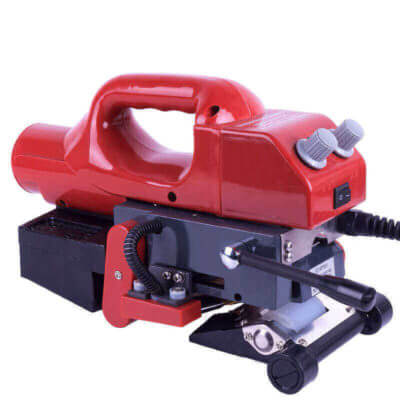
Key Features:
Dual-track seam capability: Many models create two parallel welds with an air channel between for quality testing
Precision temperature control: PID systems with imported temperature sensors maintain accurate thermal settings
Adaptive speed systems: PWM (Pulse Width Modulation) technology maintains constant speed even on slopes or vertical surfaces
Versatile material compatibility: Effectively weld HDPE, LDPE, PVC, EVA, PP, and other thermoplastics
Typical Applications:
Landfill liners and caps: Where consistent seam integrity is critical for environmental protection
Reservoir and pond liners: Large-area installations requiring watertight seals
Tunnel and basement waterproofing: Where continuous barriers are needed against water infiltration
Mining operations: Heap leach pads and solution containment areas
Operating Process:

Preparation: Clean seam area thoroughly of all dirt, moisture, and debris
Machine Setup: Set appropriate temperature (typically 300°C for 1mm material) and speed (approximately setting 3)
Alignment: Position geomembrane sheets with proper overlap (typically 10-15cm)
Welding: Engage machine to travel along seam path at consistent speed
Quality Verification: Perform air channel pressure testing on dual-track welds
Price Reference:
Basic models (800W, 0.2-1.5mm thickness): $700-$900
Standard models (800W, with PID control): $900-$1,100
Heavy-duty models (1800-2100W, 1-3mm thickness): $1900-$5,000
3. Extrusion Geomembrane Welding Machines
Extrusion welders are the problem-solvers of geomembrane installation, capable of handling complex details, patches, and materials that challenge automatic welders. These devices melt welding rod material identical to the geomembrane and extrude it onto the seam area, creating a homogeneous bond.
Key Features:
Versatile application: Ideal for detailed work in corners, protrusions, and irregular shapes
Strong patches: Creates thick, robust seams excellent for repairs
Material flexibility: Can weld a wider range of materials including textured geomembranes
Manual operation: Provides welder complete control over the deposition process
Typical Applications:
Detail work: Around pipes, drains, and penetrations through geomembrane liners
Repair operations: Fixing damaged areas in installed geomembranes
Complex geometries: Where automatic welding machines cannot maneuver
Overwelting: Adding additional seam protection in critical areas
Operating Process:
Surface Preparation: Thoroughly clean and abrade both surfaces to be joined
Pre-heating: Use the machine’s hot air capability to warm the geomembrane surfaces
Extrusion: Feed compatible welding rod into the extrusion head while maintaining consistent movement
Compaction: Immediately compact the molten bead with accompanying roller tool
Inspection: Visually examine for consistent bead appearance and proper adhesion
Price Reference:
Professional systems: $1500-$2,500
4. Hot Air Geomembrane Welding Machines
Hot air welders use heated gas (typically air) to simultaneously melt the geomembrane surface and a welding rod of compatible material. While requiring significant operator skill, these systems offer flexibility for a wide range of materials and applications.
Key Features:
Adjustable temperature: Typically 20-700°C range for various materials
Versatile material handling: Suitable for PVC, EVA, ECB, and other low-temperature materials
Lightweight and portable: Ideal for remote locations and difficult access areas
Dual operation: Can perform both welding and cutting functions
Typical Applications:
PVC liners: Commonly used in water containment applications
EVA geomembranes: Popular in mining applications
Detail work: In conjunction with automatic welding systems
Field repairs: Where portability is essential
Operating Process:
Temperature Setting: Adjust to manufacturer’s recommendation for specific material
Surface Preparation: Clean and align materials properly
Welding: Apply hot air to base material and welding rod simultaneously
Pressure Application: Use专用 (zhuānyòng, specialized) roller to ensure proper bonding
Inspection: Check for consistent weld appearance and complete fusion
Price Reference:
Basic hot air kits: $150-$300
Professional welding systems: $500-$1,200
5.Comparison of Geomembrane Welding Machine Types
The following table provides a quick reference guide to help professionals select the appropriate welding technology for their specific application:
| Feature | Hot Wedge Welder | Extrusion Welder | Hot Air Welder |
|---|---|---|---|
| Primary Use | Long, straight seams | Details, patches, repairs | PVC, EVA, details |
| Automation | High | Low | Manual |
| Skill Required | Medium | High | High |
| Production Speed | Fast (0.5-5 m/min) | Slow | Medium |
| Seam Strength | ≥85% of parent material | Can exceed parent material | 80-90% of parent material |
| Thickness Range | 0.2-3.0mm | Unlimited (with multiple passes) | 0.5-2.0mm |
| Price Range | $320-$5,000 | $400-$2,500 | $100-$1,200 |
Essential Considerations for Quality Geomembrane Welding
Environmental Factors
Successful welding requires attention to site conditions. Avoid welding during precipitation, high winds, or when temperatures approach the material’s brittleness point. Ideal conditions include:
Dry surfaces: Moisture prevents proper fusion
Moderate temperature: 5-35°C is optimal for most materials
Protected work area: Wind breaks may be necessary in exposed locations
Material Compatibility
Always verify that your welding equipment is appropriate for your specific geomembrane material:
HDPE: Requires high temperatures (typically 300-450°C)
PVC: Lower temperature range (200-300°C) to avoid degradation
PP: Moderate temperatures with longer cooling times
Reinforced materials: May require specialized approaches
Quality Assurance
Implement a systematic approach to quality control:
Pre-weld testing: Establish parameters on sample material before production welding
Process verification: Regularly monitor temperature, speed, and pressure settings
Non-destructive testing: Perform air channel testing on dual-track seams
Destructive testing: Conduct peel and shear tests on sample seams as specified by quality plans

How to Choose the Right Geomembrane Welder
Project Requirements
Material type: Ensure machine compatibility with your specific geomembrane
Seam length: Long straight seams justify automatic welders; complex layouts may require manual systems
Production demands: High-volume projects benefit from faster, automated equipment
Skill availability: Sophisticated equipment requires trained operators
Technical Specifications

Power options: Consider available site power when selecting equipment
Weight and portability: Rough terrain or remote sites may require lighter equipment
Temperature range: Verify sufficient range for your materials and ambient conditions
Weld width: Different applications require different seam configurations
Service and Support
Training availability: Manufacturer-offered training improves results
Service network: Ensure technical support is accessible for your project location
Warranty terms: Understand coverage and limitations
Parts availability: Confirm critical components are readily available
Here is also a simple guide for reference:
For large-scale HDPE liner installation → Hot wedge welding machine
For repairs, patches, and detail work → Hot air welding machine
For vertical or complex joints → Extrusion welding machine
Choosing the right equipment depends on project scale, material type, and site conditions.
Final Thoughts
The choice of a welding machine for HDPE geomembrane is not just about features,it is about matching the right technology to the specific demands of the project.
- Hot Wedge Welders provide the speed and testable quality for primary seams.
- Hot Air Welders provide the finesse and flexibility for essential detail work.
- Extrusion Welders provide the robust strength for repairs and critical connections.
As a company that both manufactures the liner and guarantees its installation, we understand that investing in high-quality, well-maintained welding equipment is a non-negotiable component of project success. It is the cornerstone of a trustworthy containment system.
If you have questions about your next project or need guidance on the appropriate installation techniques and equipment, our team of engineers and field technicians is here to help. Contact us today to ensure your project is built on a foundation of quality.Follow our Linkedin Facebook Youtube Instagram for more details.
Recent Post
Aquaculture Pond Lining in Indonesia | From Design to Installation
From Project Drawing to Water Filling: An Aquaculture Pond Lining Project in Indonesia This aquaculture pond project in Indonesia started with a project drawing.The customer firstly contacted us
When Is Geotextile Really Necessary?
When Is Geotextile Really Necessary in Civil Engineering Projects? Geotextiles are widely used in modern infrastructure and environmental engineering. However, a common question among engineers, designers, and contractors is: Is geotextile always necessary? In
Woven Polypropylene Geotextile Manufacturer | Engineering Grade & Landscape Fabric
Woven Polypropylene Geotextile Manufacturer | Engineering Grade & Landscape Fabric By Planetliner — Manufacturer of High-Performance Woven PP Fabrics for Global Projects Woven polypropylene geotextile has become a fundamental material in civil engineering, environmental protection,