

Geosynthetic Reinforced Walls And Slopes
Reinforced soil walls and steep slopes use geosynthetic tensile reinforcement to improve the stability of an engineered soil mass. The system must be designed as a structure: reinforcement strength, spacing and length work together with soil properties, facing, drainage and foundation conditions.
Planetliner supplies PET geogrids and high-strength woven geotextiles for specified reinforcement applications. Material selection should follow the wall or slope design rather than a general recommendation based only on height.
Quick Answer
PET geogrid is commonly used for long-term reinforced slopes and walls where high tensile capacity and controlled creep are required. PP geogrid and high-strength woven geotextile may also be appropriate depending on the design. Drainage is essential because uncontrolled water can increase pore pressure and reduce stability.
What Project Problems Does This Application Solve?
- Need to construct steep slopes in limited space
- Retaining structures with reinforced fill
- Bridge approaches and highway embankments
- Mining and industrial platforms
- Slope instability requiring tensile reinforcement
- Water pressure behind reinforced soil structures
Recommended Geosynthetic System
| Project Condition | Recommended Product | Primary Function | Selection Focus |
| Permanent reinforced slope | PET geogrid | Soil reinforcement | Long-term design strength |
| Reinforced soil wall | PET/PP geogrid | Tensile reinforcement | Spacing, length, connection |
| High-strength textile solution | Woven geotextile | Reinforcement | Seams and installation damage |
| Wet backfill/groundwater | Drainage geocomposite | Drainage | Flow capacity and outlet design |
How to Select the Right Materials
Engineering checks normally include internal, external and global stability, reinforcement spacing and length, connection strength, soil shear properties, design life, creep, installation damage and drainage. Product selection should follow the design tensile demand and compatible backfill conditions rather than choosing the strongest catalog grade without system analysis.
PET geogrid is an option where its tensile, creep and durability properties meet the project requirements. High-strength woven geotextile may suit designed reinforced slopes or wraparound configurations.For long-term tensile selection, consider the applicable reductions for creep, installation damage and durability. FHWA’s discussion of reduction factors explains why ultimate tensile strength alone is insufficient for conventional long-term reinforcement assessment.
PP geogrid may also be considered when the particular grade has the necessary long-term and interaction evidence. A road-stabilization grid should not be substituted into a permanent retaining wall merely because its nominal tensile strength looks similar.
| Design question | Required material or system evidence |
|---|---|
| Can reinforcement carry the design force over time? | Long-term design strength and relevant strain behavior |
| Will the reinforcement interact with the selected fill? | Pullout and interface information for representative conditions |
| Can loads reach the facing where required? | Connection performance for the actual facing and reinforcement |
| Will the material survive construction and exposure? | Installation-damage and durability assessment |
Construction and procurement details that matter
Identify the principal strength direction before cutting or laying rolls. Place reinforcement to the approved alignment and connection detail, then control fill placement and compaction. Avoid equipment movement that damages or displaces exposed material. Use appropriate compaction methods near the face.
Simple overlapping does not automatically create a load-carrying connection. Document joints, changes of grade, penetrations and obstructions. Trace rolls to their specified grade and keep installation records before each layer is buried.
For purchasing, compare the complete reinforcement schedule, test evidence, facing compatibility, roll utilization and delivery sequence. A quotation for nominal strength without design-life evidence may not be comparable with one based on a fully documented grade.
Typical Industries and Projects
This application is commonly relevant to: Transportation; Mining; Site Development.
The exact material system should be matched to the engineering function, site conditions, design life and project specification.
Project / Case Reference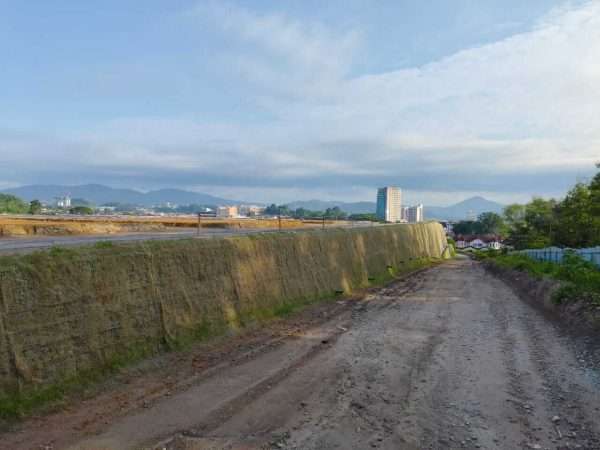

Example:A Complete Guide with PET Geogrid Projects in Malaysia. Geogrid used: Uniaxial PET geogrid, 60/30kN,80/30kN,and 100/30 kN/m tensile strength
Frequently Ask Questions
Why is PET geogrid used in reinforced slopes?
PET can provide high tensile strength with favorable long-term creep characteristics, making it useful for permanent soil reinforcement when correctly designed.
How much geogrid is needed in a retaining wall?
Reinforcement length, vertical spacing and grade are design outputs based on wall height, loading, soil properties and stability checks. A universal spacing should not be assumed.
Does a reinforced slope still need drainage?
Yes. Reinforcement does not eliminate the need to manage groundwater and infiltration. Poor drainage can undermine otherwise adequate reinforcement.
Is a reinforced soil wall cheaper than a concrete wall?
It can be economical where fill, space and construction conditions are favorable. Compare land requirements, foundation treatment, facing, drainage, reinforcement, labor and maintenance. There is no universal saving percentage.
Related Products, Industries & Solutions
Related solutions: Basal Reinforcement; Subgrade Stabilization; Erosion Control; Drainage Systems.
Related products: PET Geogrid; High-Strength Woven Geotextile.
Discuss Your Project with Planetliner
Send your project drawing, application, dimensions, soil or slurry conditions, required engineering function, existing specification and destination. Planetliner can help identify suitable geosynthetic material options, specifications and quantities for further engineering and procurement evaluation.
CTA: Send Your Project Requirements → Get a Geosynthetic Material Recommendation