
Geotextile Solutions for Road & Driveway Construction in Weak Soil & Heavy Rainfall Regions
Engineering-grade geotextile systems for contractors, infrastructure developers and government projects — designed to extend road service life and reduce maintenance cost.
Trusted by road contractors and infrastructure projects across Africa, Southeast Asia and Latin America.
We work with
Road & Highway Contractors
Infrastructure Developers
Municipal Construction Projects
Government & Public Works
Industrial & Mining Projects
Energy & Utilities Contractors
Export Projects in Africa
Southeast Asia Infrastructure
Latin America Development
Over a decade of export experience supporting road and infrastructure projects in complex soil and climate conditions.
Typical Problems We Solve
• Weak subgrade leading to settlement and rutting
• Poor drainage causing water accumulation
• Soil and aggregate layer mixing
• Premature pavement failure
• High maintenance and reconstruction cost
These problems usually originate below the surface and are invisible after construction.
Without proper geotextile separation and drainage design, road performance deteriorates rapidly — especially in weak soil and heavy rainfall regions.
A single geotextile layer, properly engineered, can determine whether a road lasts 5 years or 20 years.
Request Engineering Support
Tell us about your project. Our engineers will recommend the appropriate geotextile specification and solution based on your site conditions.
Geotextile Fabric for Road and Driveway Construction
Road and driveway performance depends far more on what lies beneath the surface than on the asphalt or concrete layer itself. In many regions—especially Southeast Asia, Africa and other developing infrastructure markets—weak soil, clay subgrades and seasonal heavy rainfall are the main causes of early road failure.
Geotextile fabric plays a critical role in road and driveway construction by stabilizing the subgrade, improving drainage and preventing aggregate contamination. When properly selected and installed, geotextile can significantly extend service life, reduce maintenance frequency and lower total project cost.
Planetliner supplies geotextile fabrics designed specifically for road and driveway applications, supporting contractors and infrastructure projects worldwide.

1.Why Geotextile Is Essential for Road Performance
Most road damage starts at the interface between the subgrade soil and the base layer. Without separation and drainage control, fine soil particles migrate upward while aggregates sink downward, resulting in:
- rutting and settlement
- loss of load-bearing capacity
- trapped moisture during rainy seasons
- accelerated cracking and surface damage
Geotextiles play four main roles in road engineering, addressing four core problems:
1).Isolation Function – Solving the “Mixed Instability” Problem
Problem: On soft soil foundations, when a crushed stone base course directly contacts the weak subgrade soil, repeated vehicle loads cause the crushed stone to sink into the soft soil, while the soft soil squeezes upwards into the crushed stone pores. This leads to a thinning of the base course, a rapid decrease in bearing capacity, and the formation of potholes and uneven settlement.
Solution: Laying geotextiles between the subgrade and base course creates a physical barrier, preventing the mixing of materials from different layers, maintaining the integrity and design function of each structural layer, and significantly extending road life.
Typical Scenarios: Road construction in soft soil, muddy, and swampy areas.
2).Reinforcement Function – Solving the “Insufficient Bearing Capacity” Problem
Problem: Soil has extremely low tensile strength, making it prone to shear failure and lateral extrusion under load, leading to subgrade instability and pavement cracking.
Solution: Embedding high-tensile-strength geotextiles in the soil, the friction between the fabric and soil diffuses the load stress over a wider area, restraining lateral deformation of the soil. This is equivalent to “putting the soil in a tight-fitting garment,” improving the overall stability and bearing capacity of the soil.
Typical Scenarios: Steep embankments, cut-fill junctions, bridge approach slab settlement prevention (reducing uneven settlement), widening roadbed joints.
3).Filtration and Drainage Function – Solving the “Water Damage” Problem
Problem: Water is one of the most significant destructive factors for roads. Water accumulation in the roadbed soil leads to softening (mud heave), frost heave and thaw settlement; simultaneously, soil particles lost with water cause voids and settlement.
Solution:
Filtration: Geotextiles allow water to pass freely (permeability) while preventing fine soil particles from being lost with the water flow (soil retention), preventing piping.
Drainage: Geotextile-based composite materials (such as drainage boards) used in conjunction with geotextiles, or geotextile-covered drainage bodies installed at specific locations, can collect and guide water laterally out of the roadbed, keeping the soil dry.
Typical Scenarios: Longitudinal drainage at roadbed edges, drainage behind retaining walls, and internal drainage systems for base/subbase courses.
4).Protective Function – Solving the Problem of “Erosion Damage”
Problem: Slopes, riverbanks, and embankments are eroded by rainwater or water flow, leading to soil erosion and slope damage.
Solution: Laying geotextiles as a subbase, covered with stones or concrete blocks, can buffer stress, prevent the underlying soil from being eroded by water flow, and provide flexible protection.
Performance requirements for road geotextiles are commonly evaluated based on internationally recognized standards for separation, filtration and reinforcement.


2.Woven vs. Nonwoven Geotextile for Road Applications
Different road conditions require different geotextile types. The two most commonly used options are woven geotextile and nonwoven geotextile.
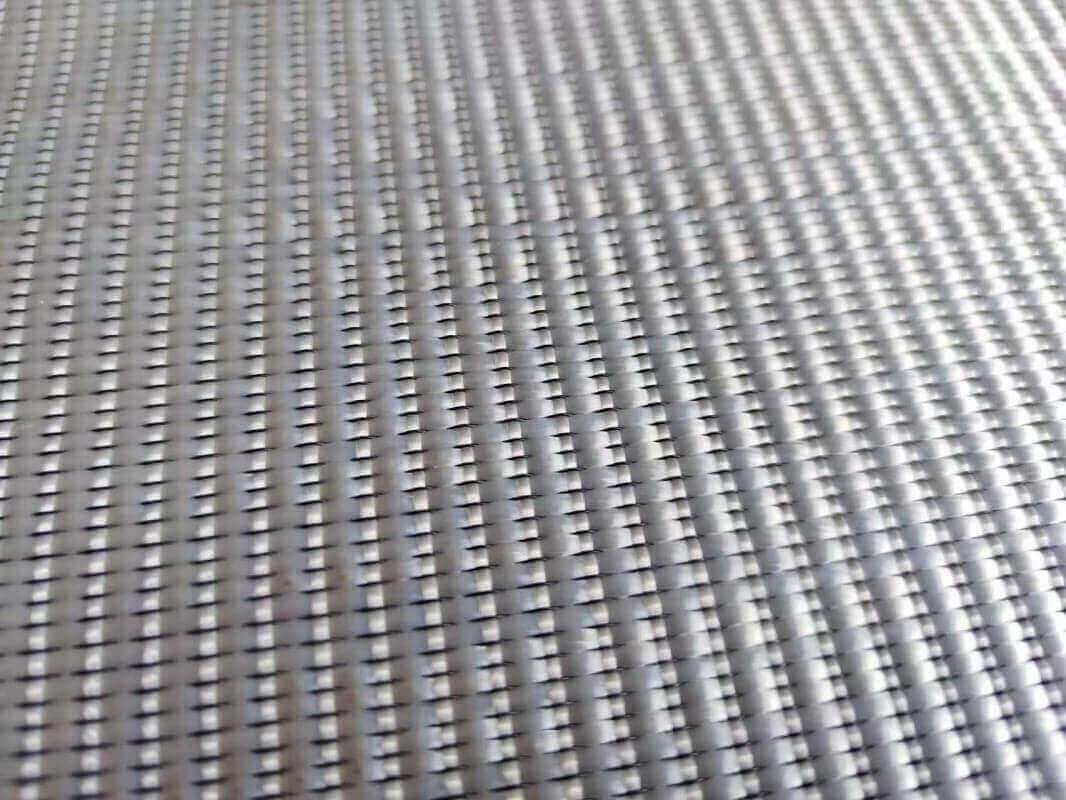
Woven Geotextile Fabric:Woven geotextile is manufactured from high-tensile polypropylene tapes and is primarily used for reinforcement and load distribution. It is commonly applied in:
- road base reinforcement
- soft soil stabilization
- areas with heavy traffic or high loads
Nonwoven Geotextile Fabric:Nonwoven geotextile is produced from polypropylene or polyester fibers bonded together through needle punching. It is widely used for:
- separation between soil and aggregates
- drainage and filtration under roads and driveways
- areas exposed to high rainfall
In many road projects, nonwoven geotextile for separation and drainage are popular, while woven geotextile is used where reinforcement strength is required.


3.Typical Geotextile Specifications for Roads and Driveways
Geotextile selection should be based on soil stabilization, traffic load and environmental factors. Common ranges include:
150–200 gsm:Suitable for residential driveways, access roads and light-traffic applications.
200–300 gsm:Commonly used for rural roads, district roads and moderate traffic loads.
300 gsm and above:Applied in weak subgrades, heavy vehicle routes and embankment reinforcement.
Planetliner assists engineers and contractors in selecting appropriate specifications based on real project conditions rather than generic assumptions.


4.Road and Driveway Applications
Geotextile fabric is widely used in various road-related applications, including:
- gravel driveways and access roads
- rural and secondary roads
- road base and subbase separation
- road shoulders and embankments
- slope protection and erosion control
By improving separation and drainage, geotextile helps ensure consistent performance across different road environments.
5.Why Choose Planetliner for Road Geotextile Fabric
Planetliner is a professional geotextile fabric manufacturer and exporter, supplying woven and nonwoven geotextile products for infrastructure projects worldwide.
Our advantages include:
consistent quality control for tensile strength and permeability
geotextile fabrics optimized for road and driveway use
export experience across Africa, Southeast Asia, Latin America and Central Asia
customized roll sizes for efficient transportation and installation
technical support based on soil conditions and application requirements
Planetliner works closely with project partners to ensure materials match real-world road performance demands.

6. Frequently Asked Questions (FAQs)
- Q: What is the best geotextile fabric for driveways?
A: Non-woven geotextile fabric is best for drainage, while woven fabric provides better stability. - Q: How long does geotextile fabric last?
A: High-quality geotextile fabric can last 3-20 years if installed correctly. - Q: Can geotextile fabric be used under concrete?
A: Yes, it prevents soil movement and improves foundation stability. - Q:What GSM geotextile is suitable for road construction?
A:Most road projects use 150–300 gsm geotextile, depending on traffic load and soil conditions. - Q:Does geotextile improve road durability in rainy regions?
A:Yes. Proper drainage and separation significantly reduce water-related damage in high-rainfall areas. - Q:Can geotextile be used under concrete or asphalt?
A:Yes. Geotextile is often installed beneath base layers to improve foundation stability before paving. - Q:Does Planetliner support international road projects?
A:Planetliner supplies geotextile fabrics for road construction projects globally with full export support.
Conclusion
Road and driveway durability is determined long before the surface layer is applied.
By improving separation, drainage and soil stability, geotextile fabric plays a decisive role in long-lasting road construction.
Planetliner provides reliable geotextile solutions for road and driveway projects, supporting infrastructure development across diverse environments.
For specifications, technical consultation or project inquiries, contact Planetliner anytime.
Recent Post
Aquaculture Pond Lining in Indonesia | From Design to Installation
From Project Drawing to Water Filling: An Aquaculture Pond Lining Project in Indonesia This aquaculture pond project in Indonesia started with a project drawing.The customer firstly contacted us
When Is Geotextile Really Necessary?
When Is Geotextile Really Necessary in Civil Engineering Projects? Geotextiles are widely used in modern infrastructure and environmental engineering. However, a common question among engineers, designers, and contractors is: Is geotextile always necessary? In
Woven Polypropylene Geotextile Manufacturer | Engineering Grade & Landscape Fabric
Woven Polypropylene Geotextile Manufacturer | Engineering Grade & Landscape Fabric By Planetliner — Manufacturer of High-Performance Woven PP Fabrics for Global Projects Woven polypropylene geotextile has become a fundamental material in civil engineering, environmental protection,