Geosynthetic Sealing Barrier &Containment Systems Solutions
Containment systems are designed to control the migration of water, wastewater, leachate, process liquids, chemicals or gases. The most reliable solution is not only a single liner, It is a designed system in which the barrier, protection and drainage layers work together.
Planetliner supplies HDPE and LLDPE geomembranes, geosynthetic clay liners, geotextiles and drainage materials for containment projects. Send your drawings and operating conditions to discuss material options for your engineer’s review.
Quick Answer
For most long-term containment projects, HDPE geomembrane is a common primary barrier because of its low permeability, chemical resistance and durability. LLDPE can be considered where greater flexibility or deformation capacity is required. On slopes, textured geomembrane can improve interface friction. GCL, protection geotextile and drainage geocomposites can be added where the design requires a composite barrier, puncture protection or liquid/gas drainage.
What Project Problems Does This Application Solve?
- Water loss from reservoirs, ponds and canals
- Migration of leachate or industrial liquids
- Chemical exposure in mining and process ponds
- Slope interface stability in lined facilities
- Puncture risk from subgrade, aggregate or waste
- Leak collection and drainage beneath or above the barrier
Recommended Geosynthetic System
| Project Condition | Recommended Product | Primary Function | Selection Focus |
| Flat containment area | Smooth HDPE geomembrane | Barrier | Chemical exposure, thickness, subgrade |
| Settlement or complex Shape | LLDPE geomembrane | Barrier | Elongation and deformation capacity |
| Steep lined slope | Textured geomembrane | Barrier + interface friction | Slope angle and interface shear |
| Composite environmental barrier | Geomembrane + GCL | Low-permeability barrier | Regulation and leakage criteria |
| High puncture risk | Nonwoven geotextile | Protection | Normal stress and puncture resistance |
| Drainage/leak collection | Geonet or drainage geocomposite | In-plane drainage | Long-term transmissivity |
How to Select the Right Materials?
Start with the contained medium and design life, then review chemical compatibility, hydrostatic pressure, subgrade condition, slope geometry, expected settlement, puncture risk, UV exposure and installation conditions. Do not select a containment liner only by thickness or price. For critical facilities, interface shear, long-term durability, welding quality and the complete liner-system configuration can be more important than one nominal property.
| Material | Where it may fit | What to verify |
| HDPE geomembrane | Exposed ponds, waste facilities and process-water containment | Chemical compatibility, temperature, stress-crack resistance and installation conditions |
| LLDPE geomembrane | Details or substrates requiring greater flexibility | Allowable deformation, durability and compatibility with the contained liquid |
| Textured geomembrane | Interfaces where slope shear resistance matters | Project-specific interface shear testing; texture alone does not establish stability |
| Geosynthetic clay liner | A bentonite barrier, including approved composite liner configurations | Hydration, confinement, liquid chemistry and internal/interface shear behavior |
| Composite geomembrane | Factory-combined membrane and textile configurations | Actual membrane properties, bonding and how exposed edges will be sealed |
Typical Industries and Projects
This application is commonly relevant to: aquaculture, water, waste, mining and energy facilities.
The exact material system should be matched to the engineering function, site conditions, design life and project specification.
Build a system with a defined function for every layer
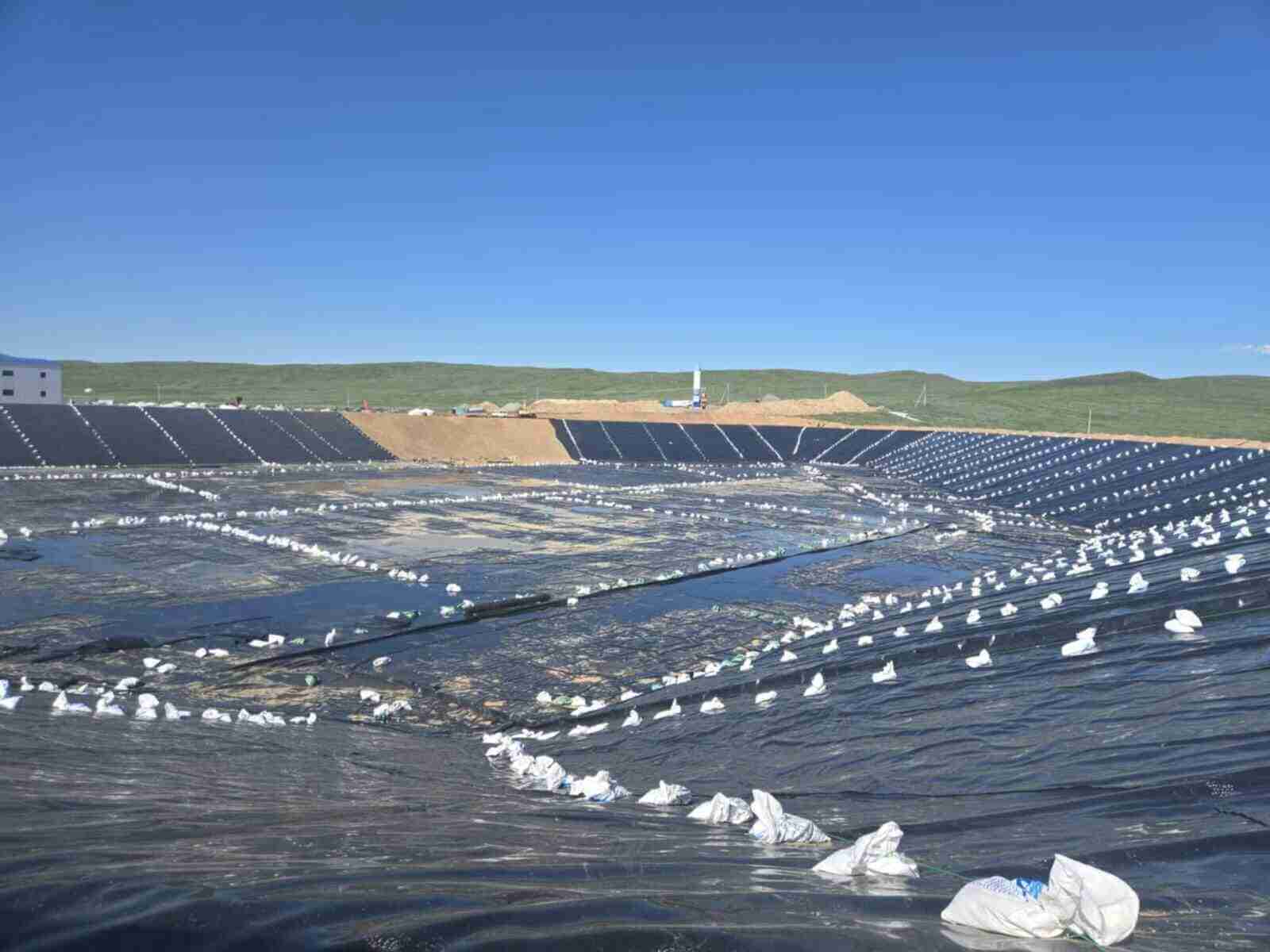
A lining design may include a prepared foundation, a geosynthetic barrier systems and a nonwoven protection geotextile selected for the adjacent material and loading. A GCL may work with a geomembrane where the design requires a composite barrier. Protection placement must preserve the contact conditions needed by that design.
Drainage systems can collect liquid above a liner or relieve groundwater below it. These are different duties. In a double-liner design, a dedicated collection layer between the primary and secondary barriers can form part of a leak-detection system when connected to suitable sumps and monitoring arrangements.
Secondary containment also requires compatible penetrations, sufficient containment volume and controlled drainage. Final landfill caps require separate decisions about settlement, gas management, infiltration and erosion protection.
Specify performance before comparing prices
Share the stored liquid and concentration, temperature range, water depth, foundation conditions, slope geometry, expected exposure and design life. These inputs help establish membrane grade, thickness, protection and testing requirements. A thicker sheet cannot compensate for poor welding or unstable ground.
Where specified, use GRI-GM13 for HDPE and GRI-GM17 for LLDPE as material specification references. Ask for the applicable revision, product-specific test results and batch traceability. A reference to a specification is not evidence that every supplied roll complies, or that the finished facility meets its operating requirements.
Before filling, the construction quality plan should address foundation acceptance, trial welds, seam testing, repairs, penetrations and records. Electrical leak-location testing may be appropriate where the installation and survey method are compatible.
Project / Case Reference
Example: an aquaculture customer in Indonesia provided pond drawings before procurement. The project required quantity estimation and a suitable HDPE liner specification. During installation, incomplete welding was observed in sections of double-track welds. The troubleshooting process focused on trial welding, temperature, travel speed, pressure, surface cleanliness and equipment condition before the project proceeded toward water filling. This type of project shows why material selection and installation quality control must be considered together.
Frequently asked questions
What is the difference between HDPE and LLDPE for containment?
HDPE is commonly selected for chemical resistance, stiffness and long-term containment; LLDPE offers greater flexibility and elongation where deformation or complex geometry is important.
Do I need geotextile under a geomembrane?
Use a protection geotextile when the subgrade or adjacent material creates a meaningful puncture or abrasion risk. The required grade should be based on loading and protection performance, not GSM alone.
When is textured geomembrane used?
It is commonly considered on slopes where higher interface friction is required. The final choice should be supported by the project’s slope and interface-shear requirements.
When should GCL be combined with geomembrane?
Composite barrier systems are common where additional hydraulic performance or redundancy is required, particularly in environmental containment.
Related Products, Industries & Solutions
Related solutions: Drainage Systems; Separation & Filtration.
Related products: HDPE Geomembrane; LLDPE Geomembrane; Textured Geomembrane; GCL.
Related industries: Water; Waste; Mining; Aquaculture; Energy.
Discuss Your Project with Planetliner
Send your project drawing, application, dimensions, soil or slurry conditions, required engineering function, existing specification and destination. Planetliner can help identify suitable geosynthetic material options, specifications and quantities for further engineering and procurement evaluation.
CTA: Send Your Project Requirements → Get a Geosynthetic Material Recommendation