

Geotextile Separation & Filtration Solutions
Separation and filtration are two of the most common geotextile functions, but they should not be treated as the same requirement. Separation prevents dissimilar soil or aggregate layers from mixing; filtration allows water to pass while retaining the required soil particles.A single geotextile can perform both functions when its mechanical and hydraulic properties match the site.
Planetliner supplies nonwoven, high-strength woven and woven PP geotextiles. The right choice starts with the soil and water conditions, not simply the fabric weight or whether the material looks woven.
Quick Answer
Nonwoven geotextiles are widely used where filtration, drainage and protection are important. Woven geotextiles are often selected where separation must be combined with higher tensile strength or stabilization. The correct fabric should be selected using soil retention, hydraulic and survivability criteria rather than GSM alone.
What Project Problems Does This Application Solve?
- Fine subgrade pumping into aggregate
- Loss of drainage performance due to soil migration
- Need to retain soil while allowing water flow
- Aggregate contamination in roads and working platforms
- Filter layer beneath riprap or drainage stone
- Need for puncture-resistant separation during construction
Recommended Geosynthetic System
| Project Condition | Recommended Product | Primary Function | Selection Focus |
| Drainage trench/filter | Nonwoven geotextile | Filtration | AOS, permittivity, clogging |
| Road separation | Woven geotextile | Separation + strength | Tensile and survivability |
| Riprap/erosion filter | Nonwoven geotextile | Filtration + separation | Soil retention and puncture |
| Weak subgrade | Woven or nonwoven geotextile | Separation | Construction survivability |
How to Select the Right Materials
| Product type | Potential use | Important qualification |
|---|---|---|
| Needle-punched nonwoven geotextile | Filtration, separation and cushioning | Match opening size, flow and installation resistance to the duty |
| High-strength woven geotextile | Separation combined with a specified tensile role | Verify hydraulic properties as well as tensile performance |
| Engineering-grade woven PP fabric | Selected separation applications | Confirm actual properties; light weed-control fabric is not an engineering substitute |
| A purpose-selected woven filter fabric | Applications where its pore structure suits the soil and flow | Obtain filtration evidence rather than assuming all woven fabrics behave alike |
Review soil particle-size distribution, expected water flow, apparent opening size, permittivity/permeability, tensile strength, elongation, CBR puncture resistance and installation survivability. A heavier fabric is not automatically a better filter. A filter that is too open can lose soil; one that is too restrictive may reduce drainage or become vulnerable to clogging.
Specify a filter that retains soil and passes water
Begin with soil particle-size distribution, fines content, permeability and expected hydraulic conditions. Consider whether flow is steady, reversing or cyclic, and whether the site has clogging-sensitive or unusual soils.
The selection must balance retention, permeability and resistance to clogging. An opening that is too large can permit unacceptable soil loss; a poorly matched pore structure can restrict flow. More fabric mass does not automatically improve that balance.
Specify the applicable opening-size and hydraulic test methods. Results reported using different methods or boundary conditions should not be treated as directly interchangeable. For demanding conditions, a soil–geotextile compatibility test may be more informative than a generic catalogue comparison.
Where water must travel along the system to an outlet, also review geosynthetic drainage. Filtration through a fabric is different from drainage along a collection layer.
Protect the filter during installation
Prepare a reasonably even surface and remove protrusions that could puncture the fabric. Select overlaps or seams for the ground conditions and installation method. Avoid gaps, excessive tension and contamination with wet soil before the filter is covered.
Control stone size, drop height and construction traffic. Beneath riprap, a bedding layer or more robust protection arrangement may be required. Check that the installed filter remains continuous around transitions and penetrations. A correctly specified fabric cannot perform across an uncovered gap.
For procurement, request a data sheet, test methods, declared property basis, roll identification and packing dimensions. Include overlaps, seams and expected cutting losses in quantity estimates. Compare the complete installed filter arrangement, not only the price per square metre.
Typical Industries and Projects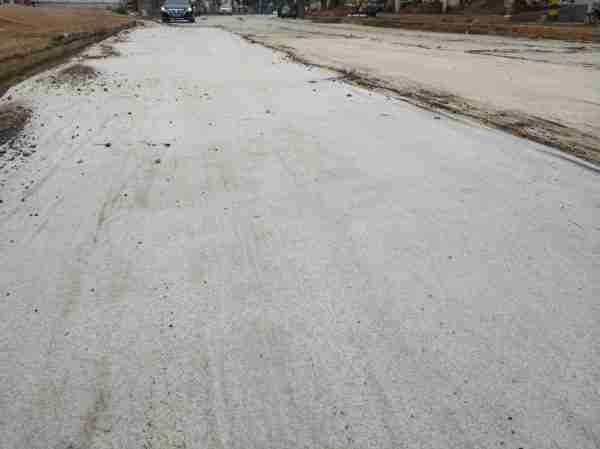

This application is commonly relevant to: Transportation; Water; Waste; Mining; Coastal & Waterways. The exact material system should be matched to the engineering function, site conditions, design life and project specification.
Explore transportation, water infrastructure, waste facilities and mining. For trafficked weak ground, see subgrade stabilization.
Project / Case Reference
Example: under a road aggregate layer, geotextile can prevent fine subgrade from migrating upward and aggregate from punching downward. In a drainage trench, the same product family is selected primarily for hydraulic filtration. The application changes the controlling properties, so one specification should not be copied blindly between projects.
Frequently asked questions
Woven or nonwoven geotextile for filtration?
Nonwoven geotextile is commonly preferred where hydraulic filtration is the primary function. Woven geotextile is often chosen when separation and tensile strength are more important.
What does AOS mean?
Apparent opening size is an index used to characterize geotextile pore opening and is one factor in matching the filter to the retained soil.
Is GSM enough to select a geotextile?
No. GSM identifies mass per unit area but does not define filtration, hydraulic, tensile or puncture performance by itself.
Can geotextile replace a granular filter?
It can replace or supplement a granular filter in suitable designs. The decision must address soil retention, flow, clogging, durability and installation survivability. It is not an automatic substitution.
Is the heaviest fabric the best filter?
No. Mass per unit area does not establish pore size, water flow or compatibility with the soil. Select measured properties for the intended function.
What should an overseas buyer send for a quotation?
Provide the application, soil report or grading, specification, roll dimensions, quantity and destination. If the specification is incomplete, identify which properties need engineering confirmation before purchase.
Related Products, Industries & Solutions
Related solutions: Subgrade Stabilization; Drainage Systems; Erosion Control.
Related products: Nonwoven Geotextile; Woven Geotextile.
Discuss Your Project with Planetliner
Send your project drawing, application, dimensions, soil or slurry conditions, required engineering function, existing specification and destination. Planetliner can help identify suitable geosynthetic material options, specifications and quantities for further engineering and procurement evaluation.
CTA: Send Your Project Requirements → Get a Geosynthetic Material Recommendation