

Wastewater Pond Liners for Industrial Effluent and Treatment Lagoons
A wastewater pond looks simple when it is empty.It is an excavated basin with a liner.But once the pond begins operating, the system becomes more complicated.Wastewater chemistry changes. Solids settle. Aerators move. Pumps operate. Groundwater can rise below the lagoon liner. Gas can accumulate underneath it. Eventually, sludge has to be removed.For contractors, the correct liner decision is therefore not:“What thickness of HDPE should we buy?”
The more useful question is:“What conditions will this liner experience from construction through cleaning and maintenance?”
What Is a Wastewater Pond Liner?
A wastewater pond liner is a flexible barrier installed over the bottom and side slopes of a wastewater pond, effluent pond or treatment lagoon.The liner helps control liquid migration between the pond and surrounding ground.Applications may include:
- industrial effluent ponds;
- equalization ponds;
- treatment lagoons;
- settling ponds;
- emergency containment ponds;
- treated-effluent storage
- manure lagoons
This page deals specifically with earth ponds and lagoons.For tanks, concrete basins and broader treatment-facility lining systems, use the separate Wastewater Treatment Linings page.
First Identify the Pond Function
Two ponds on the same wastewater plant may need different designs.
Equalization pond
Receives changing flow and chemistry.
Treatment lagoon
May contain biological treatment and aeration equipment.
Settling pond
Receives solids that gradually accumulate.
Emergency pond
May remain empty for long periods.
Effluent storage pond
Stores treated or partly treated water.
The pond function helps predict the real operating risks.
Describe the Wastewater Before Selecting the Liner
The word “wastewater” is not enough.A useful project review should include:
| Wastewater Information | Why It Matters |
|---|---|
| pH | Chemical environment |
| Main chemicals | Material compatibility |
| Concentration | Exposure severity |
| Temperature | Long-term material condition |
| Suspended solids | Sludge and abrasion |
| Oils/hydrocarbons | Compatibility review |
| Cleaning chemicals | Maintenance exposure |
If the wastewater changes during production, provide the expected operating range rather than only one laboratory result.
Why Chemical Compatibility Is More Than “HDPE Is Resistant”
HDPE geomembrane is widely used in wastewater containment, but no responsible selection should rely on a generic statement that one material resists every chemical.Compatibility depends on:
- chemical type;
- concentration;
- temperature;
- duration of exposure.
Where the wastewater contains unusual chemicals or elevated temperature, the project should receive a specific compatibility review.
Temperature Should Be Included in Every Industrial RFQ
This is frequently forgotten.Wastewater leaving an industrial process may be significantly warmer than ambient water.
Contractors should provide:
- normal operating temperature;
- maximum short-term temperature.
This allows material selection to reflect the real operating condition.
Subgrade Is the First Protection Layer
Before geomembrane deployment, the pond foundation should be:
- stable;
- smooth;
- free of sharp objects;
- free of uncontrolled soft zones.
Potential puncture sources include:
- rock;
- construction debris;
- roots;
- old concrete.
Where the base is rough, nonwoven geotextile may be used as a cushioning layer.The liner should not be expected to hide poor earthworks.
Groundwater Can Lift the Liner From Below
This is one of the most important wastewater-lagoon risks.When the pond is full, the stored water pushes the liner downward.When the pond is drained for maintenance, groundwater may push upward.If enough pressure develops, the liner can lift locally.
This may appear as:
- bubbles;
- floating areas;
- folds.
Before construction, the contractor should review:
- seasonal groundwater;
- site drainage;
- low points;
- whether the pond will be emptied regularly.
Where required, the design may include underliner drainage or pressure relief.
Gas Can Produce Similar Symptoms
Groundwater is not the only source of uplift.Gas can accumulate below a geomembrane where the underlying soil contains organic material or other gas-producing conditions.This means a bubble under the liner is not automatically evidence that the membrane itself has failed.The underlying cause should be investigated.
Sludge Is the Long-Term Problem Many Projects Ignore
Wastewater ponds may look clean at commissioning.Over time, solids settle.Eventually, the owner needs to remove sludge.
Possible methods include:
- pumping;
- dredging;
- flushing;
- mechanical excavation.
This maintenance event may create more mechanical risk than years of normal pond operation.
Plan Sludge Removal Before the Pond Is Built
Ask:How will this pond be cleaned five years from now?
If the answer is “with an excavator,” the project should consider protected working areas.
Possible strategies may include:
- protected access ramps;
- sacrificial cover areas;
- geotextile and cover material;
- dedicated sludge zones.
A steel bucket should not be allowed to scrape directly across exposed geomembrane.
Aerators and Mixers Need Dedicated Protection
Treatment lagoons may use:
- floating aerators;
- diffusers;
- mixers;
- anchor cables;
- pipes.
These components move during operation.Repeated contact with the membrane can create damage.The support system should therefore be coordinated with the liner design rather than installed later as an unrelated mechanical package.
Pipe Penetrations Are Small but Important
Large open membrane panels are normally easier than pipe details.
Wastewater ponds may include:
- inlet pipes;
- outlet pipes;
- pump lines;
- overflow structures;
- level-control pipes.
Finalize the pipe layout before geomembrane deployment.Every late penetration means additional field cutting and detailing.
Inlets Can Create Local Erosion
A high-flow inlet can repeatedly discharge water and solids onto one area.This may move protective cover or create abrasion.Where necessary, the hydraulic design should include an energy-dissipation or protected inlet area.
HDPE or LLDPE for Wastewater Ponds?
HDPE is commonly selected for large wastewater ponds because it is widely available for field-welded containment systems and is used in many industrial applications.Some lagoon liners need the chemical resistance requirement.
LLDPE may be considered where greater flexibility or deformation capacity is useful.
The decision should consider:
- chemistry;
- temperature;
- foundation movement;
- pond geometry;
- exposure;
- project specification.
How Thick Should a Lagoon Liner Be?
There is no universal thickness.
Selection may depend on:
- subgrade;
- pond depth;
- equipment contact;
- protection layer;
- project specification.
For detailed thickness comparison, link to the dedicated geomembrane-thickness page.
Side Slopes and Anchor Areas
Slope areas require:
- stable subgrade;
- sufficient working room;
- proper anchoring;
- safe installation access.
Do not allow unrelated construction traffic to use the liner anchor zone as a normal access road.
Maintenance After Commissioning
Routine inspection should focus on areas that remain accessible:
- slopes;
- anchor zones;
- pipe penetrations;
- aerator zones;
- known repairs.
After sludge cleaning or major equipment work, inspect the liner before refilling.
What Should a Contractor Send for a Wastewater Pond Quote?
| Information | Example |
|---|---|
| Pond type | Equalization / treatment / settling |
| Wastewater | Industrial / municipal |
| Chemistry | pH + major constituents |
| Temperature | Normal + peak |
| Dimensions | Drawing |
| Depth / slopes | Cross-section |
| Groundwater | Known / unknown |
| Cleaning method | Pump / excavator |
| Material spec | If available |
| Destination | Port / country |
A drawing plus wastewater information is much more useful than an enquiry saying only:
“Need 20,000 m² wastewater liner.”
Common Contractor Mistakes
The most common problems are not complicated:
- selecting the liner before reviewing wastewater data;
- ignoring peak temperature;
- failing to investigate groundwater;
- no sludge-removal strategy;
- allowing aerator hardware to rub against the membrane;
- changing pipes after installation;
- assuming a bubble automatically means leakage.
These issues should be solved during planning, not after the pond enters operation.
A project example

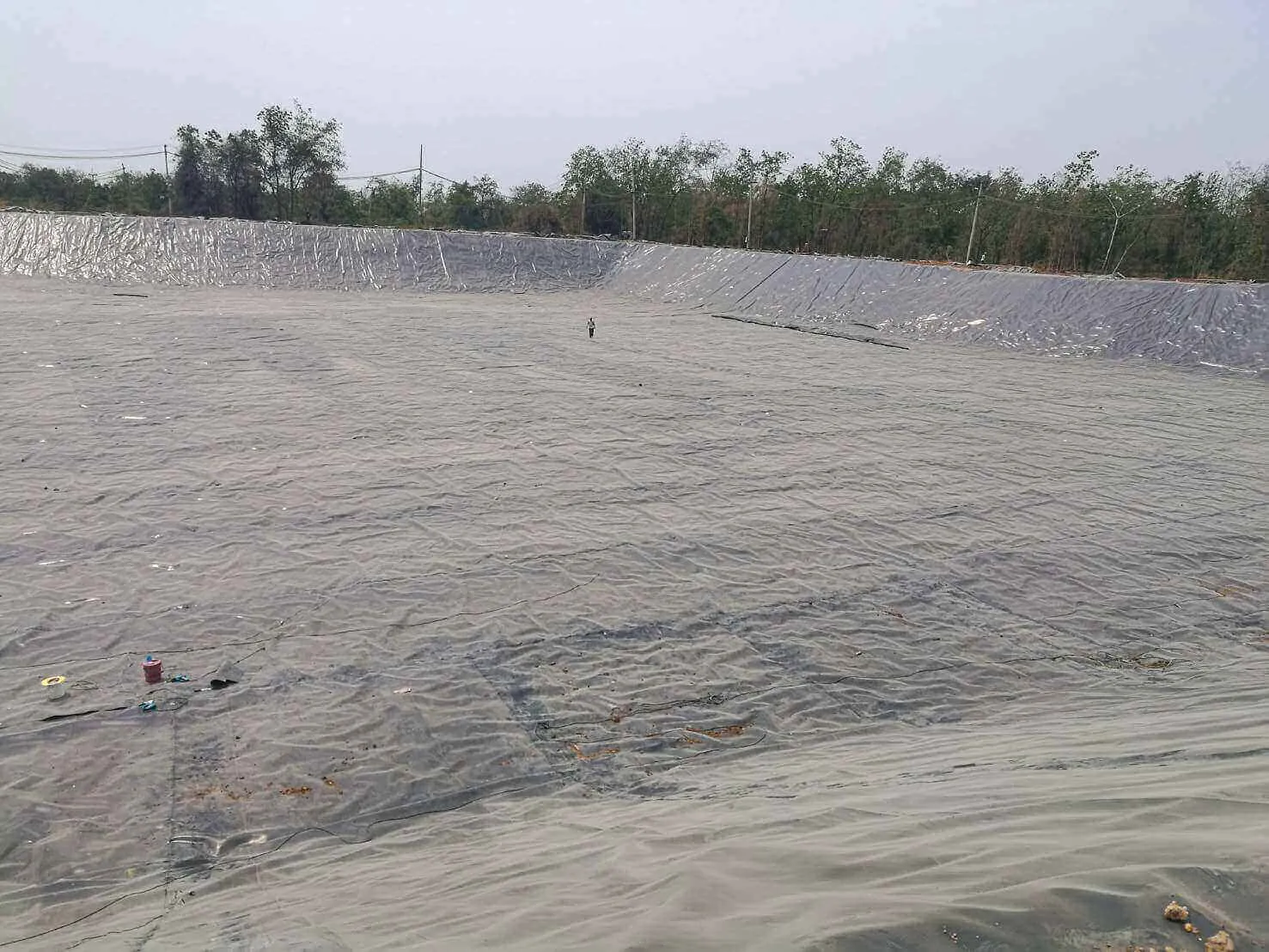
These are our Thailand water treatment project, which use 1mm thickness HDPE liner.
FAQ
What is the best liner for a wastewater pond?
There is no universal best liner. Wastewater chemistry, temperature, subgrade, equipment and maintenance should all be considered.
Is HDPE suitable for industrial wastewater?
It is widely used, but actual chemical compatibility should be checked for the specific liquid and temperature.
Why does a wastewater pond liner bubble?
Groundwater or gas pressure beneath the membrane can cause local uplift.
Can aerators be installed in a geomembrane-lined lagoon?
Yes, but the supports, anchors and moving components should not create uncontrolled contact with the liner.
How should sludge be removed from a lined pond?
The cleaning method should minimize direct contact between heavy equipment and exposed geomembrane.
Does wastewater temperature affect liner selection?
Yes. Continuous and peak temperatures should be included in the material review.
What information is required for quotation?
Provide wastewater chemistry, temperature, pond drawings, depth, slopes, groundwater conditions, cleaning method, specification, quantity and destination.