
Which is the best Geotextile Fabric in 2024?
Geotextile fabric is becoming more and more popular in many industries,because it its durability, and environmental benefits. If you have construction projects, for example, landscaping, civil engineering,road construction,airport,landfill,mining projects and others, it is very helpful to understand the types of geotextile fabric.
Our company is a manufacturer and supplier of Geotextile fabric for more than 10years, we have the nonwoven geotextile,woven geotextile, Polyester and Polypropylene material, the weight gsm and the size can be customzied according to the requirements.
What is Geotextile Fabric?
Geotextile fabric is a kind of synthetic material,which is widely used in ground stabilization, drainage, reinforcement,erosion control and protection applications. The Geotextile material are polyester or polypropylene, this fabric is durable, water-permeable, and resistant to environmental wear and tear. The Geotextile fabric advantages have Light weight, low cost, corrosion resistance, with reverse filtration, drainage, isolation, enhancement and other excellent performance.
Types of Geotextile Fabric
There are different types of geotextile fabric, the two main type are woven geotextile and non woven geotextile.The production process is different, and the property is different, so the benefits and price are also different. It is better to know these features for your projects.
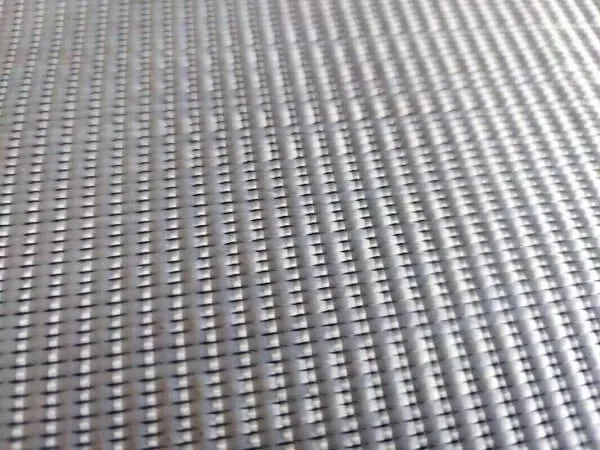
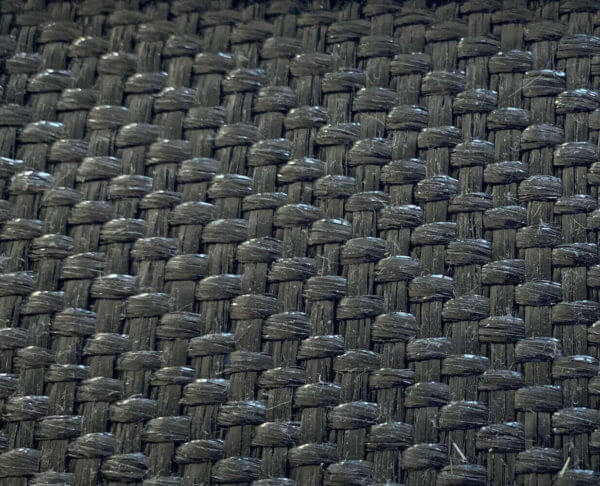
Woven geotextile fabric is made by weaving individual Continuous filament fabric together, like traditional cloth. This type of geotextile is known as its high tensile strength, so it is very suitable for the civil engineering project, which require soil stabilization, such as road construction. The woven geotextile fabric has a high property, so the lifetime is longer.
Our woven geotextile have PET and PP woven geotextile,
PET woven geotextile:100/50 200/50 300/50 400/50 600/50 800/50 1000/50 1200/50 1600/50 KN/m
PET woven geotextile:50/50 65/65 70/70 100/100 110/110 120/120 150/150 200/200 300/300 600/600 KN/m
The roll size is 5.2x100m normally.
| PROPERTIES | Test Method | Units | 100/50 | 150/50 | 200/50 | 300/50 | 400/50 | 500/50 | 600/50 | 800/50 | 1000/50 | 1200/50 | 1600/50 |
| Strength@ Ultimate(MD) | ASTM D4595/ ISO 10319 | kN/m | 100 | 150 | 200 | 300 | 400 | 500 600 | 800 | 1000 | 1200 | 1600 | |
| Strength@ Ultimate(CD) | ASTM D4595/ ISO 10319 | kN/m | 50 | 50 | 50 | 50 | 50 | 50 50 | 50 | 50 | 50 | 50 | |
Elongation | ASTM D4595/ ISO 10319 | % | 9±2 | 9±2 | 10±2 | 10±2 | 10±2 | 10±2 10±2 | 10±2 | 10±2 | 10±2 | 10±2 | |
| Strength@5% Strain(MD) | ASTM D4595/ ISO 10319 | kN/m | 50 | 64 | 80 | 110 | 188 | 235 282 | 376 | 470 | 564 | 752 | |
| Apparent Pore Open Size | ASTM D4751/ ISO 12956 | mm | 0.05-0.5 | ||||||||||
Water Flow Rate | ASTM D4491/ ISO 11058 | l/m2/s | 1-15 | ||||||||||
| Roll size – Width x Length | – | m | 5.2×100 | ||||||||||
Non Woven Geotextile Fabric

Nonwoven geotextile is a permeable geosynthetic material, it is made of filament or staple fiber.The geotextile is frequently made from polymers synthetic material,like Polyester material and the Polypropylene material.
The nonwoven geotextile use the needle punched process, make fibers interweave with each other, and make the geotextile soft,stiff and reach a technical property requirement.
Nonwoven geotextiles have good fabric clearance and good adhesion. Because the geotextile fiber has tear resistance ability and good deformation adaptability, and also has good drainage ability. The geotextile surface is soft and multi-clearance, has good friction, which can increase the adhesion ability of soil particles.
The nonwoven geotextile can be continuous filament nonwoven geotextile and staple nonwoven geotextile.All the geotextile have a good filtration, isolation, reinforcement, protection and other functions.The nonwoven geotextile is a widely used geosynthetic materials. Filament geotextile has higher tensile strength than short staple geotextile, can be selected according to application requirements.
| Items | 150g | 200g | 250g | 300g | 350g | 400g | 450g | 550g | 600g | 700g |
| Deviation per unit area,% | -8 | -8 | -8 | -7 | -7 | -7 | -7 | -6 | -6 | -6 |
| Thickness, mm | 1.8 | 2.1 | 2.5 | 2.9 | 3.2 | 3.6 | 3.9 | 4.5 | 5.0 | 5.7 |
| Tensile strength MD/CD, KN/M | 7.5 | 10 | 12.5 | 15 | 17.5 | 20.5 | 22.5 | 26 | 30 | 35 |
| Elongation, % | 25-100 | |||||||||
| Tear Strength, KN | 0.21 | 0.28 | 0.35 | 0.42 | 0.49 | 0.56 | 0.63 | 0.76 | 0.82 | 0.95 |
| CBR Puncture Strength ,KN | 1.4 | 1.8 | 2.2 | 2.6 | 3.0 | 3.5 | 4.0 | 5.0 | 5.5 | 6.5 |
| EOSØ90(Ø95), mm | 0.07-0.2 | |||||||||
| Vertical Permeability Coefficient cm/s | Kx(10-1-10-3),K=1.0-9.9 | |||||||||
The features of nonwoven geotextile
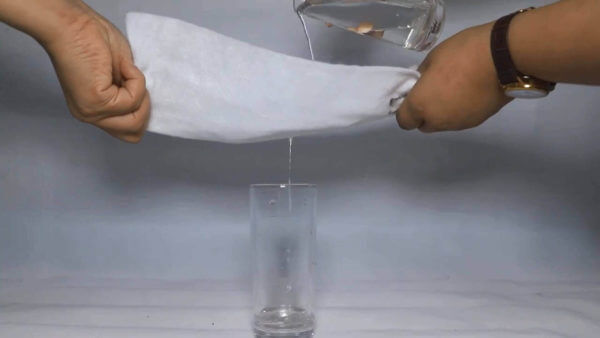
- Soil Stabilizationor Reinforcement:One of the primary uses of geotextile fabric is soil stabilization. By laying down geotextile fabric, you can prevent soil erosion and keep the ground stable. This is particularly useful in construction sites, roads, and embankments where soil movement could compromise the project’s integrity.nonwoven geotextile is used in reinforcement to increase the load bearing capacity of the soil.The reinforcement is a popular application in the road engineering.Nonwoven geotextile can reduce the stress level in the foundation soil.
- Drainage:Geotextile fabric is also widely used for drainage projects. The fabric allows water to pass through while keeping soil particles outside. This is particularly beneficial in agricultural fields, sports fields, and even residential gardens.Nonwoven geotextile is used to transport the liquids or gas.It can be combined with other products,like geonet,pipes etc.
- Erosion Control:Erosion is a significant problem in many landscapes, but geotextile fabric can help control it effectively. By covering exposed soil with geotextile cloth, you can prevent erosion caused by wind, rain, or runoff. This is especially important in areas prone to landslides or in coastal regions.
- Isolation:Use polyester staple needle-punched geotextile to isolate building materials (such as soil and sand, soil and concrete, etc.) with different physical properties (particle size, distribution, consistency and density, etc.). This prevents two or more materials from flowing or mixing, maintains the overall structure and function of the materials, and enhances the bearing capacity of the structure.
5.Filtration:nonwoven geotextile can retain fine soil particles.The geotextile can prevents the soil from going through the geotextile.
6.Separation:nonwoven geotextile can help to separate two layers of soil,which have different size of particles.Geotextile prevents the two layers of soil from mixing together.Nonwoven geotextile is very important for the long term performance of the structure.
Why Choose Geotextile Cloth?
Geotextile cloth, whether woven or non-woven, offers a range of benefits that make it a popular choice in various industries. Its durability, flexibility, and environmental benefits make it suitable for both large-scale construction projects and smaller landscaping tasks.
Durability: Geotextile cloth is resistant to chemicals, UV rays, and environmental wear and tear. This makes it a long-lasting solution for projects that require ground reinforcement or erosion control.
Flexibility: Whether you choose woven or non-woven geotextile, the fabric’s flexibility allows it to conform to various surfaces, making it easier to install and adapt to different project needs.
Environmental Benefits: Geotextile fabric is designed to be environmentally friendly. It reduces soil erosion, improves water filtration, and helps maintain soil structure without the need for harmful chemicals.
How to Choose the Right Geotextile Fabric
When selecting geotextile fabric for your project, consider the following factors:
Project Type: Determine whether your project requires soil stabilization, drainage, or erosion control. This will help you decide whether woven or non-woven geotextile is more suitable.
Soil Conditions: The type of soil you’re working with will also influence your choice of geotextile fabric. For example, sandy soils may benefit more from woven geotextile, while clay soils might require non-woven geotextile for better filtration.
Load-Bearing Requirements: If your project involves heavy loads, such as road construction or retaining walls, opt for woven geotextile fabric due to its higher tensile strength.
Geotextile fabric Application areas
(1) As reinforcement in retaining wall backfill, or for anchoring retaining wall panels. Construction of wrapped retaining walls or bridge abutments.
(2) Reinforcement of flexible pavement, repair of cracks on the road, and prevention of crack reflection on the pavement.
(3) Increase the stability of gravel slopes and reinforced soil, prevent soil erosion and frost damage of soil at low temperatures.
(4) Isolation layer between road ballast and roadbed, or between roadbed and soft foundation.
(5) Isolation layer between artificial fill, rock pile or material yard and foundation, isolation between different frozen soil layers. Anti-filtration and reinforcement effect.
(6) Filter layer of the initial upstream dam surface of ash storage dam or tailings dam, filter layer of drainage system in retaining wall backfill.
(7) Filter layer around drainage pipes or gravel drainage ditch.
(8) Filter layer of wells, pressure relief wells or inclined pressure pipes in water conservancy projects.
(9) Geotextile isolation layer between the foundation of roads, airports, railway tracks and artificial rockfill.
(10) Vertical or horizontal drainage inside earth dams, buried in the soil to dissipate pore water pressure.
(11) Drainage behind the anti-seepage geomembrane or under the concrete face in earth dams or earth embankments.
(12) Eliminate seepage around tunnels, reduce the external water pressure on the lining and seepage around buildings.
(13) Drainage of artificial fill foundations and sports fields.
(14) Used to strengthen weak foundations in projects such as roads (including temporary roads), railways, embankments, earth-rock dams, airports, and sports fields.
How to install the Geotextile fabric?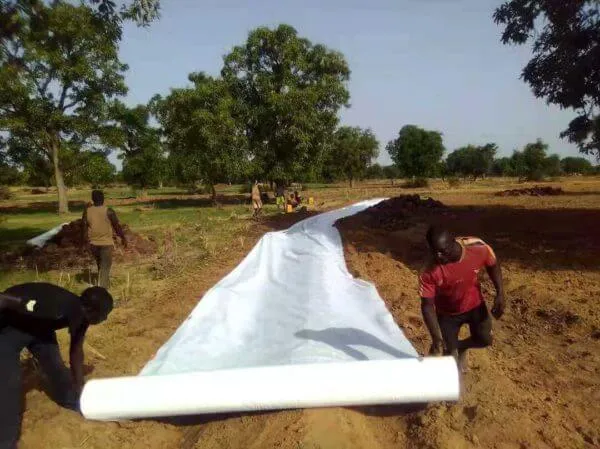
Geotextile fabric rolls should be protected from damage before installation. Geotextile rolls should be stacked in a flat, water-free place, with a height of no more than four rolls, and the identification sheet of the roll can be seen. Geotextile rolls must be covered with opaque materials to prevent UV aging. During storage, the integrity of the labels and the integrity of the information must be maintained. During transportation (including on-site transportation from the material storage site to the work site), geotextile rolls must be protected from damage.
Geotextile rolls that have been physically damaged must be repaired. Severely worn geotextiles cannot be used. Any geotextile that has been exposed to leaked chemical reagents is not allowed to be used in this project.
- Use manual rolling, the surface of the fabric should be flat, and an appropriate deformation margin should be left.
- The installation of filament or short-filament geotextiles usually uses overlapping, sewing and welding methods. The width of sewing and welding is generally more than 0.1m, and the overlap width is generally more than 0.2m. Geotextiles that may be exposed for a long time should be welded or sewn.
- Sewing of geotextiles:All sewing must be continuous (i.e., spot stitching is not allowed). Geotextiles must overlap by at least 150 mm before overlapping. The minimum stitch distance from the selvedge (exposed edge of the material) is at least 25 mm.The sewn geotextile seams include at least one row of wired lock chain stitching. The thread used for sewing should be a resin material with a minimum tension of more than 60N and have chemical corrosion and UV resistance equivalent to or exceeding that of the geotextile.Any “missed stitches” on the sewn geotextile must be re-sewn at the affected location.Appropriate measures must be taken to prevent soil, granular material or foreign matter from entering the geotextile layer after installation.The overlap of the fabric can be divided into natural overlap, sewing or welding according to the terrain and use function.
- During construction, the geotextile above the geomembrane is naturally overlapped, and the geotextile above the geomembrane is sewn or hot air welded. Hot air welding is the preferred method for connecting filament geotextiles, that is, using a hot air gun to instantly heat the connection of the two pieces of cloth to a high temperature, so that part of it reaches a molten state, and immediately use a certain external force to firmly bond them together. In humid (rainy and snowy) weather, when hot bonding cannot be performed, the geotextile should adopt another method, the suture connection method, that is, double-line suture connection with a special sewing machine, and chemical UV-resistant sutures.The minimum width for suture is 10cm, the minimum width for natural overlap is 20cm, and the minimum width for hot air welding is 20cm.
- For seams, sutures of the same quality as the geotextile should be used, and the sutures should be made of materials with stronger resistance to chemical damage and ultraviolet light.
- After the geotextile is laid and approved by the on-site supervision engineer, the geomembrane is laid.
- The geotextile on the geomembrane is laid in the same way as above after the geomembrane is approved by Party A and the supervisor.
- The corresponding numbers of each layer of geotextile are TN and BN.
- The upper and lower geotextiles of the membrane should be buried in the anchor groove together with the geomembrane in the area with the anchor groove.
Basic requirements for laying geotextiles:
- The joints must intersect with the slope line; where the slope foot is balanced or stress may exist, the distance of the horizontal joints must be greater than 1.5m.
- Anchor one end of the geotextile on the slope, and then lower the roll to the slope to ensure that the geotextile remains taut.
- All geotextiles must be pressed down with sandbags, which will be used during laying and retained until the upper layer of material is laid.
Our group have more than 400people, the 2023 total sales amount is 448 Million USD dollar,could support you on many projects.Our price list and samples can be sent for check, and i can visit you every 1-3month for face to face talk and for long term cooperation.
Welcome your inquiry,my Facebook and linkedin.
Recent Post
Aquaculture Pond Lining in Indonesia | From Design to Installation
From Project Drawing to Water Filling: An Aquaculture Pond Lining Project in Indonesia This aquaculture pond project in Indonesia started with a project drawing.The customer firstly contacted us
When Is Geotextile Really Necessary?
When Is Geotextile Really Necessary in Civil Engineering Projects? Geotextiles are widely used in modern infrastructure and environmental engineering. However, a common question among engineers, designers, and contractors is: Is geotextile always necessary? In
Woven Polypropylene Geotextile Manufacturer | Engineering Grade & Landscape Fabric
Woven Polypropylene Geotextile Manufacturer | Engineering Grade & Landscape Fabric By Planetliner — Manufacturer of High-Performance Woven PP Fabrics for Global Projects Woven polypropylene geotextile has become a fundamental material in civil engineering, environmental protection,